





Contents

Cosmesi Industria
The Practical Guide to Surface Science (2026)

598c5d776e4cd0caded4ddd2b3d4cb0ec1ecbcd738224b42594a3e0dc88910d0?s=100&d=m
Written by
superioradmin
No biography added yet.
Read More
598c5d776e4cd0caded4ddd2b3d4cb0ec1ecbcd738224b42594a3e0dc88910d0?s=100&d=m
Reviewed by
N/A
No biography added yet.
Read More
598c5d776e4cd0caded4ddd2b3d4cb0ec1ecbcd738224b42594a3e0dc88910d0?s=100&d=m
Written By

No biography added yet.

598c5d776e4cd0caded4ddd2b3d4cb0ec1ecbcd738224b42594a3e0dc88910d0?s=100&d=m
Reviewed By

N/A N/A

No biography added yet.

This is a practical guide to Surface Science for researchers working in the Cosmetics Industry.

In this all-new guide you’ll learn all about:

  • Crucial surface science principles
  • The significance of surface science measurements for the Cosmetics industry
  • Applicable ASTM Standards & Guidelines

Let’s dive right in.

Cosmesi

Executive Summary

What it covers: A practical surface-science guide for cosmetics that explains how contact angle (static + advancing/receding), surface tension (static + dynamic), surface energy, and sliding angle measurements connect to spreading, adhesion, penetration, and stability. It also includes benchmark reference data, real-world case studies, and a standards/reporting checklist for reliable results.
Key insights: Dynamic measurements (advancing/receding contact angles and dynamic surface tension) capture real-world behavior better than single static values, especially on rough/heterogeneous surfaces or fast-changing interfaces. Young–Laplace fitting typically gives more consistent contact-angle results for near-axisymmetric drops, while polynomial fitting tolerates asymmetry but is more sensitive to local surface defects, and method identity matters (optical pendant-drop ≠ ASTM D1331).
Business value: Helps R&D and QA teams optimize feel and performance (e.g., sunscreen film uniformity, moisturizer penetration, mascara wear) by tuning wetting and interfacial behavior with measurable targets. Improves troubleshooting and lot-to-lot consistency by using benchmarks and controlled reporting to quickly flag contamination, treatment drift, or surfactant/process shifts that drive instability (e.g., emulsion phase inversion).
Standards to follow: Use ASTM D1331 when specs/claims require surface or interfacial tension via Du Noüy ring/Wilhelmy plate force tensiometry, and report key controls (temperature, equilibration time, prep/cleaning protocol, replicates/statistics, and deviations). Use optical pendant-drop internally for fast screening, but don’t label it D1331—instead, validate and document a bridging correlation to a D1331 reference method if compliance decisions depend on it.
Bottom line: A cosmetics-focused, measurement-first playbook showing what to measure, when to use each method, and how to interpret/report results so formulation decisions and QC gates become faster, more repeatable, and easier to defend. It turns “surface behavior” into practical knobs for stability, sensory performance, and process robustness.

Chapter 1: Introduction

Understanding how cosmetics interact with the skin relies on the surface tension of liquids and the contact angle, that a liquid droplet generates when it meets a solid surface. These characteristics directly impact the product performance and user experience by influencing how they spread, adhere, and enter the skin.

Cosmetic formulation combines art and science to create products that embellish and enhance a person’s natural attractiveness. Striking the ideal balance between practicality and beauty can be challenging. Cosmetic formulators ensure products withstand everyday use while maintaining their aesthetic appeal by prioritizing


Cosmetics icons

We use the following surface properties to understand the behavior of Cosmetics products and improve their quality.

Chapter 2: Contact Angle Measurement

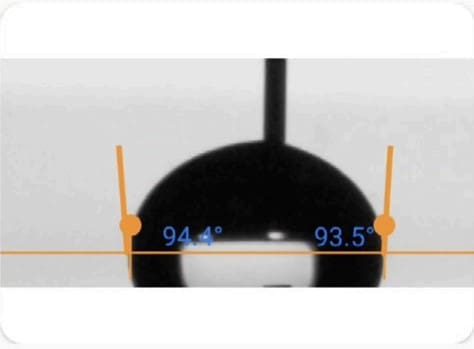
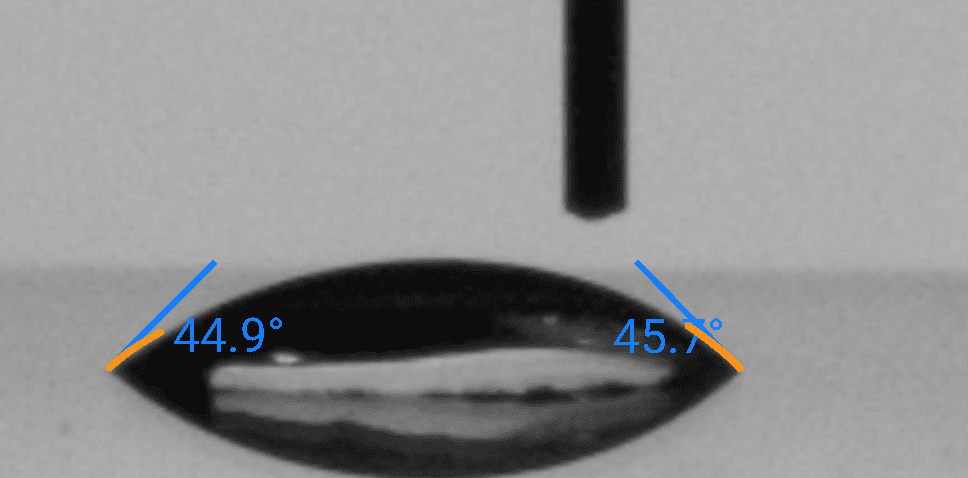
The contact angle quantifies the wettability of a surface by representing the angle between a liquid’s surface and a solid surface.
Dropletlab Research

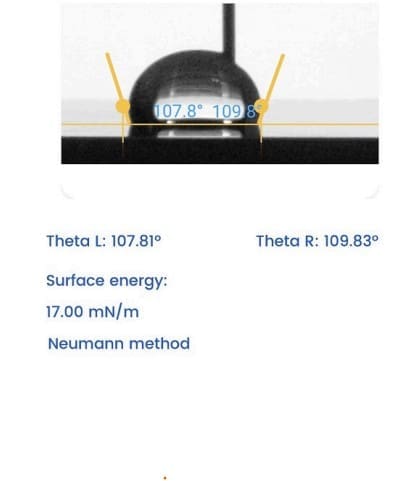
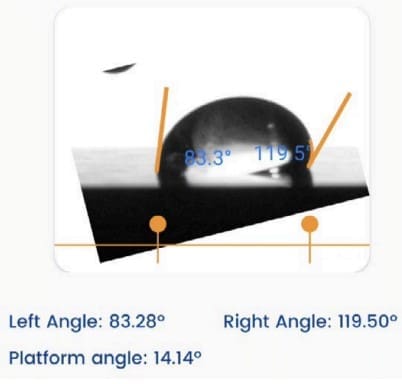
Sample Image taken from Droplet Lab Tensiometer.

Young – Laplace Method

Metodo polinomiale

Dynamic Contact Angle

Ideally, when we place a drop on a solid surface, a unique angle exists between the liquid and the solid surface. We can calculate the value of this ideal contact angle (the so-called Young’s contact angle) using Young’s equation. In practice, due to surface geometry, roughness, heterogeneity, contamination, and deformation, the contact angle value on a surface is not necessarily a single consistent value but rather falls within a range. The upper and lower limits of this range are known as the advancing and receding contact angles, respectively. The values of advancing and receding contact angles for a solid surface are highly sensitive to many parameters, such as temperature, humidity, homogeneity, and minor contamination of the surface and liquid. For example, the advancing and receding contact angles of a surface can differ at different locations.

Dynamic Contact Angle versus Static Contact Angle

Practical surfaces and coatings naturally show contact angle hysteresis, indicating a range of equilibrium values. When we measure static contact angles, we get a single value within this range. Solely relying on static measurements poses problems, like poor repeatability and incomplete surface assessment regarding adhesion, cleanliness, roughness, and homogeneity.

In practical applications, we need to understand how easily a liquid spreads (advancing angle) and how easily it is removed (receding angle), such as in painting and cleaning. Measuring advancing and receding angles offers a holistic view of liquid-solid interaction, unlike static measurements, which yield an arbitrary value within the range.

This insight is crucial for real-world surfaces with variations, roughness, and dynamics, aiding industries like cosmetics, materials science, and biotechnology in designing effective surfaces and optimizing processes.

Learn how Contact Angle measurement is done on our Tensiometer

For a more complete understanding of Contact Angle measurement, read our Contact Angle measurement: The Definitive Guide

Open Benchmark Data: Contact Angle & Surface Energy

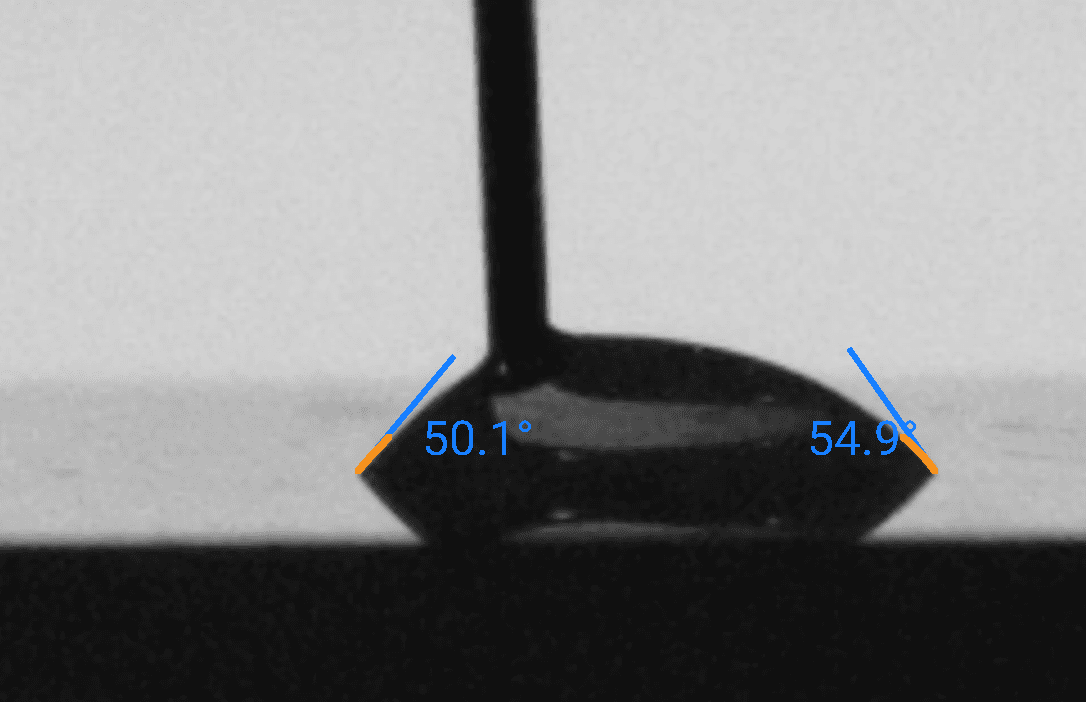
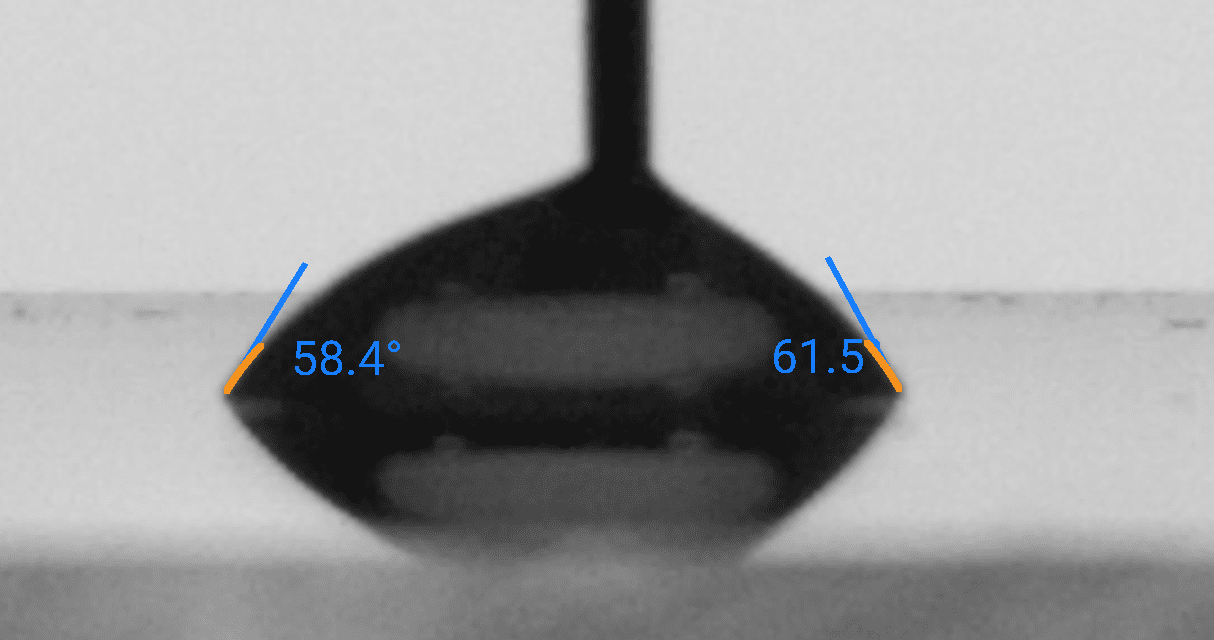
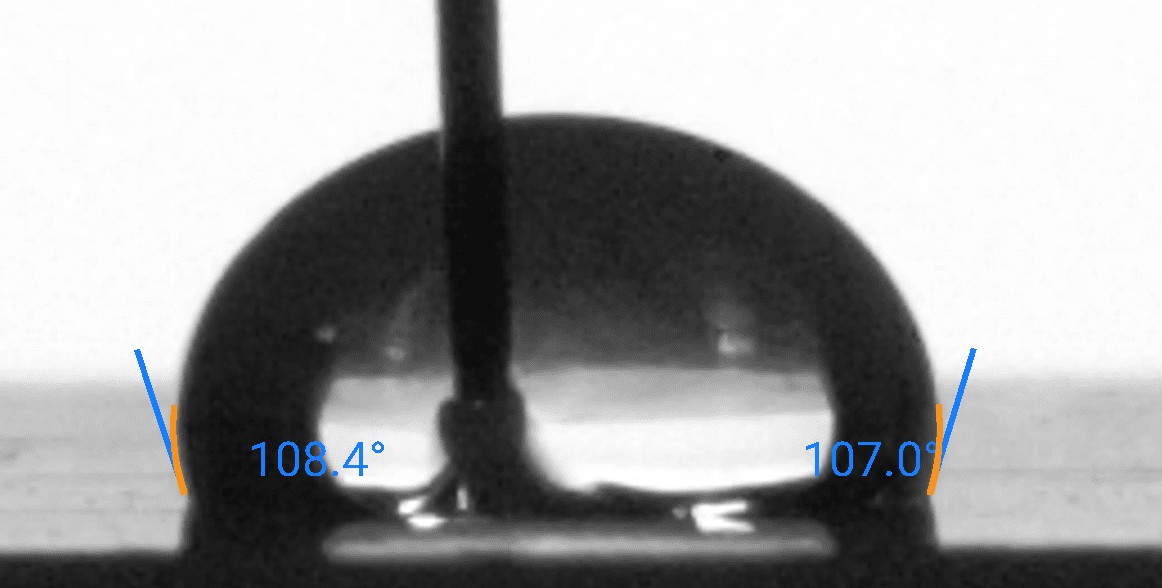
These reference measurements show how deionized water wets four standard substrates measured with the Droplet Lab Dropometer. Use them as visual and numerical benchmarks when you're checking your own sample preparation, treatments, and chemistry.

Full contact angle and surface energy datasets (including additional liquids and statistics) are available on our dataset hub.

Glass - DI Water
Glass - DI Water
Nylon - DI Water
Nylon - DI Water
PMMA - DI Water
PMMA - DI Water
Teflon - DI Water
Teflon - DI Water

The droplet images above are taken from the same benchmark series as our open dataset. For each substrate and probe liquid we report:

● Advancing and receding contact angles (and hysteresis)
● Derived surface energy (SFE) values based on multi-liquid measurements
● Measurement conditions, uncertainties, and sample preparation details

Comparing your own droplet shapes and angles against these references is a fast way to spot contamination, treatment drift, or unexpected changes in wettability.

Chapter 3: Surface Tension Measurement

This property measures the force that acts on the surface of a liquid, aiming to minimize its surface area.

Misurazione della tensione superficiale

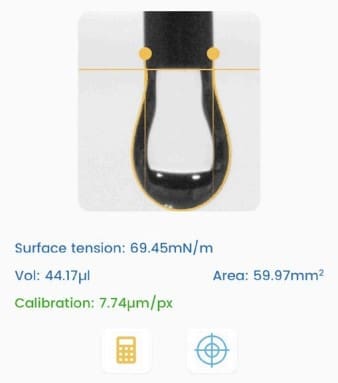
Sample Image taken from Droplet Lab Tensiometer

Dynamic Surface Tension

Dynamic surface tension differs from static surface tension, which refers to the surface energy per unit area (or force acting per unit length along the edge of a liquid surface).

Static surface tension characterizes the equilibrium state of the liquid interface, while dynamic surface tension accounts for the kinetics of changes at the interface. These changes could involve the presence of surfactants, additives, or variations in temperature, pressure, and composition at the interface.

When to use Dynamic Surface Tension Measurement

Dynamic surface tension is essential for processes that involve rapid changes at the liquid-gas or liquid-liquid interface, such as droplet and bubble formation, coalescence (change in surface area), the behavior of foams, and the drying of paints (change in composition, e.g., evaporation of solvent). It is measured by analyzing the shape of a hanging droplet over time.

Dynamic surface tension applies to various industries, including cosmetics, coatings, pharmaceuticals, paint, food and beverage, and industrial processes, where understanding and controlling the behavior of liquid interfaces is essential for product quality and process efficiency.

Learn how Surface Tension measurement is done on our Tensiometer

For a more complete understanding of Surface Energy measurement, read our Surface Tension measurement: The Definitive Guide

Chapter 4: Surface Energy Measurement

Surface energy refers to the energy required to create a unit area of a new surface.
231

Sample Image taken from Droplet Lab Tensiometer

Learn how Surface Energy measurement is done on our Tensiometer

For a more complete understanding of Surface Energy measurement, read our Surface Energy measurement: The Definitive Guide

For benchmark contact angle and surface energy values on glass, nylon, PMMA, and Teflon, see the Open Benchmark Data panel above or visit our Dataset Hub for full CSV downloads.

Chapter 5: Sliding Angle Measurement

The sliding angle measures the angle at which a liquid film slides over a solid surface. It is commonly employed to assess the slip resistance of a surface.

sliding angle 1

Sample Image taken from Droplet Lab Tensiometer

Learn how Sliding Angle measurement is done on our Tensiometer

For a more complete understanding of Sliding Angle measurement, read our Sliding Angle Measurement: The Definitive Guide

Chapter 6: Real-World Applications

Within the Cosmetics industry, several case studies exemplify the advantages of conducting surface property measurements.

Formulating More Stable Mineral-Oil Cosmetic Emulsions: Using Cellulose Nanocrystals and Surfactant Type/Level to Control Phase Inversion

This study presents the first quantitative comparison of catastrophic phase inversion behavior of water-in-oil emulsions stabilized by nanocrystalline cellulose (NCC) and molecular surfactants with different headgroup charge types: anionic (sodium dodecyl sulfate referred to as SDS), cationic (octadecyltrimethylammonium chloride referred to as OTAC), nonionic (C12–14 alcohol ethoxylate referred to as Alfonic), and zwitterionic (cetyl betaine referred to as Amphosol). By using conductivity measurements under controlled mixing and pendant drop tensiometry, this study shows that NCC markedly delays catastrophic phase inversion through interfacial jamming, whereas surfactant-stabilized systems exhibit concentration-dependent inversion driven by interfacial saturation. Specifically, NCC-stabilized emulsions exhibited a nonlinear increase in the critical aqueous phase volume fraction required for inversion, ranging from 0.253 (0 wt% NCC) to 0.545 (1.5 wt% NCC), consistent with enhanced resistance to inversion typically associated with the formation of rigid interfacial layers in Pickering emulsions. In contrast, surfactant-stabilized systems exhibited a concentration-dependent inversion trend with opposing effects. At low concentrations, limited interfacial coverage delayed inversion, while at higher concentrations, increased surfactant availability and interfacial saturation promoted earlier inversion and favored the formation of oil-in-water structures. Pendant drop tensiometry confirmed negligible surface activity for NCC, while all surfactants significantly lowered interfacial tension. Despite its weak surface activity, NCC imparted strong coalescence resistance above 0.2 wt%, attributed to steric stabilization. These findings establish distinct mechanisms for governing phase inversion in particle- versus surfactant-stabilized systems. To our knowledge, this is the first study to quantitively characterize the catastrophic phase inversion behavior of water-in-oil emulsions using NCC. This work supports the use of NCC as an effective stabilizer for emulsions with high internal phase volume.

Role of the Droplet Lab Goniometer

  • The study used a Droplet Lab smartphone-based pendant drop tensiometer to quantify surface tension (aqueous–air) and interfacial tension (aqueous–mineral oil) via Young–Laplace / ADSA fitting (Methods, Section 2.5).
  • These measurements were central for differentiating mechanisms:
    • NCC: minimal surface activity (little surface tension reduction), yet strong emulsion stabilization via interfacial jamming/steric stabilization.
    • Surfactants (SDS, OTAC, Alfonic, Amphosol): significant reductions in surface/interfacial tension, aligning with concentration-dependent phase inversion behavior (Results, Section 3.2).
  • Where the surface/interfacial tension measurements are mentioned: Methods Section 2.5 (pendant drop tensiometry details) and Results Section 3.2 (Surface Tension and Interfacial Tension; Figures 8–9).
  • Contact angle note: The paper discusses “contact angle hysteresis” only as prior literature context; it does not report contact angle measurements in the experiments.

Key Findings

  • NCC substantially delayed catastrophic phase inversion of W/O emulsions, increasing the critical aqueous volume fraction for inversion from 0.253 (0 wt% NCC) to 0.545 (1.5 wt% NCC) (Results 3.1; Figures 1–2).
  • Surfactant systems showed non-monotonic inversion behavior:
    • At low surfactant concentrations, inversion was delayed (interpreted as limited interfacial coverage providing kinetic stabilization).
    • At higher concentrations, inversion occurred earlier (interpreted as interfacial saturation and easier formation of O/W structures) (Results 3.1; Figure 7).
  • Droplet Lab pendant drop data distinguished NCC vs surfactants clearly:
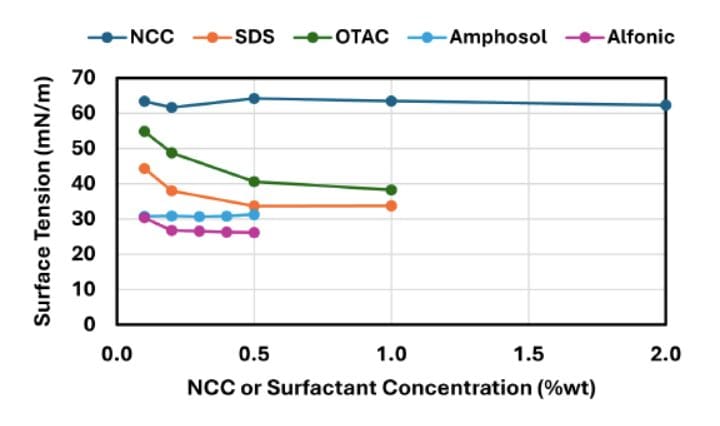
    • NCC surface tension stayed high (~63 mN/m range across tested concentrations), indicating weak surface activity (Results 3.2.1; Figure 8).
    • Surfactants reduced surface tension strongly (e.g., Alfonic and Amphosol reaching lower values than ionic surfactants in the tested range) (Results 3.2.1; Figure 8).
    • Interfacial tension: Surfactants caused large IFT drops vs NCC (Results 3.2.2; Figure 9).

Coalescence resistance improved with NCC ≥ 0.2 wt%, supporting NCC as an effective Pickering-style stabilizer even without strong surface tension reduction (Results 3.3; Figure 10).

Why it matters

Cosmetic creams, lotions, and cleansing products rely on controlled emulsion type (W/O vs O/W), stability, and texture under mixing and storage. This study shows that a bio-based particulate stabilizer (NCC) can expand the “safe processing window” by delaying catastrophic phase inversion and improving coalescence resistance, even when it does not substantially lower surface tension. For formulators, that translates into practical levers: using NCC to support high internal phase emulsions (richer textures / higher water loading) and using Droplet Lab surface/interfacial tension measurements to set QC specifications and avoid surfactant “overdosing” regimes where inversion can occur earlier during processing.

Method Snapshot

  • Sample: Aqueous phases containing NCC or surfactants (SDS/OTAC/Alfonic/Amphosol) with white mineral oil (WO-15) as the oil phase.
  • Droplet Lab pendant drop tensiometry: 10–20 µL pendant droplet, 22 ± 1 °C, Young–Laplace / ADSA fitting; surface tension measured with droplet in air and interfacial tension with droplet in oil (Methods, Section 2.5).

Angle type: N/A (no contact angle measurements; pendant drop tensiometry used instead).

Data Note

Figure 8 reports surface tension vs concentration for NCC and surfactants (measured using the Droplet Lab pendant drop tensiometer; Results 3.2.1).

Figure

Citation (APA Format)

Kim, D., & Pal, R. (2025). Influence of cellulose nanocrystals and surfactants on catastrophic phase inversion and stability of emulsions. Colloids and Interfaces, 9(4), 46. https://doi.org/10.3390/colloids9040046

View Publication →

1. Amplifying Sunscreen’s Shield

Sunscreen does more than just block the sun—it forms a protective barrier between our delicate skin and relentless ultraviolet rays. Understanding the underlying science behind this solution has been crucial. When researchers examined contact angles between sunscreen droplets and skin, they discovered that optimizing them would provide a more uniform, reliable, resilient, and longer-lasting protective layer. This data also suggested the possibility of a sunscreen that felt less like a mask and more like a second skin—a sunscreen you could wear without feeling weighed down.

1. Amplifying Sunscreen’s Shield

2. Hydration on a Whole New Level

Moisturizers are key to healthy skin, but not all are created equal. That initial silky feel might seem important, but prioritizing long-lasting hydration is key to a successful moisturizer. Researchers explored the droplet contact angles and found that the moisturizer would penetrate deeper when these angles were optimized, allowing them to nourish multiple layers and not just the surface. Imagine a moisturizer that works round the clock to provide lasting, deep-rooted hydration. That’s science and innovation combined.

2. Hydration on a Whole New Level

3. Crafting the Perfect Mascara

Everyone wants a mascara that stays put, but how do you scientifically make that possible? Researchers found the answer by exploring how mascara bonds with the skin and eyelashes. By examining the contact angles of mascara droplets, formulators identified a formula for smudge-free, long-lasting wear. With this precision, wearers can say goodbye to regular touch-ups and hello to the confidence that lasts.

3. Crafting the Perfect Mascara

4. Tailored Elegance in Color Cosmetics

The world of color cosmetics is vast and complex. Formulators realized they could bridge the gap between color, texture, and individual skin types. Cosmetic research enables products that don’t just sit on the skin but become a part of it, or at least take on that appearance.

Precision-measured interactions mean cosmetics can adapt and respond to different skin conditions, leading to a more personalized beauty experience. This is more than an enhancement— a revolution in users’ relationship with their makeup.

4. Tailored Elegance in Color Cosmetics

5. Eco-Elegance: Green Cosmetology

The environment matters to both consumers and businesses, and sustainable cosmetics have become a necessity. Industry-wide ventures into surface science have optimized product performance and championed environmental responsibility. By understanding molecular-level interactions, researchers assist formulators in creating efficient and eco-friendly products. In a world grappling with environmental challenges, this research and insight offer a beacon of hope and a roadmap for a greener future in cosmetics.

At the heart of these tales is a common thread: the undeniable power of surface property measurements. When wielded with precision and insight, they transform challenges into success stories, ensuring that pigments do more than just color surfaces; they also interact, adhere, and last.

5. Eco-Elegance: Green Cosmetology

We are your partners in solving your Business & Technological challenges

If you are interested in implementing these or any other applications, please contact us.

Chapter 7: Standards and Guidelines

In an industry where precision reigns supreme, how can Cosmetics manufacturers ensure their products withstand scrutiny? The answer lies in standards and guidelines: the compass that guides them through the complex maze of quality and performance.

ASTM D1331 — Surface & Interfacial Tension of Solutions (Du Noüy Ring / Wilhelmy Plate Force Methods)

What it is

ASTM D1331 is a method-defined standard for measuring surface tension and interfacial tension of liquids using force tensiometry, where a Du Noüy ring or Wilhelmy plate is pulled from a liquid or across an interface. Results should only be labeled “ASTM D1331” when produced using these ring/plate force methods (optical pendant-drop methods are not D1331 as-written).

When to use it

Specs, claims, or customer requirements referencing ASTM D1331

Use when a brand, contract manufacturer, or customer specification explicitly requires “ASTM D1331” values for release, COAs, or dispute resolution.

Root-cause and verification for formulation/process changes

Use as a reference method when changing surfactant systems, adding oils/silicones, adjusting solvents/fragrance loads, or troubleshooting spreading/foam/emulsion issues where tension is a sensitive indicator.

In-scope / Out-of-scope

In scope
  • Surface tension of cosmetic-relevant liquids (e.g., surfactant solutions, toners, fragrances/solvent blends, low-viscosity oils) measured by ring/plate force tensiometry.
  • Interfacial tension between two phases (e.g., water/oil, water/silicone, water/fragrance phase) using ring/plate approaches to support emulsion design and contamination checks.
  • QC trending and lot-to-lot comparison when sampling, temperature control, and cleaning are standardized.
  • Surfactant-containing systems (common in cleansers/shampoos) provided equilibration timing and cleanliness controls are documented.
Out of scope
  • Optical pendant-drop (Young–Laplace) measurements (e.g., Dropometer pendant drop) and other non-force optical methods—these are not ASTM D1331 compliant as-written.
  • Contact angle/wetting on packaging or substrates (requires contact-angle standards/methods, not D1331).
  • High-viscosity, yield-stress, or strongly structured products (e.g., thick creams, gels) where ring/plate detachment and equilibrium assumptions become unreliable without a validated internal method adaptation.
  • Labeling non-ring/plate results as “ASTM D1331” (method name is not interchangeable with the property name).

Minimum you must report (checklist)

  • Sample identity and matrix (product type, formulation code, lot/batch; key ingredients that impact tension such as surfactants, oils/silicones, solvents/fragrance load).
  • Measurement type (surface tension vs interfacial tension; for interfacial, specify both phases and which is continuous/dispersed if applicable).
  • Instrument and geometry (Du Noüy ring or Wilhelmy plate; material and relevant dimensions/ID).
  • Temperature and equilibration (setpoint, measured temperature, time since mixing, rest/equilibration time before measurement).
  • Sample preparation (degassing/settling, filtration if used, dilution details, avoidance of bubbles/foam, handling to prevent silicone contamination).
  • Cleaning/conditioning protocol for ring/plate and vessels (solvents, rinses, burn/flame steps if used, acceptance check with a reference liquid).
  • Replicates and statistics (n, mean/median, SD/IQR; any rejection/outlier rule).
  • Method settings and deviations (pull speed/measurement mode if instrument requires; any deviations from ASTM D1331 or your internal SOP and rationale).

Note: Dropometer (optical pendant-drop Young–Laplace) can be an excellent fast internal screen for surfactant drift, contamination, or batch variability, but it must not be reported as “ASTM D1331” because it does not use ring/plate force tensiometry. If you want D1331-equivalent decisions from a faster method, establish a documented method-bridging correlation against a ring/plate D1331 reference.

How to interpret results (guardrails)

  • Treat results as method-specific: ring/plate and pendant-drop can differ systematically; do not assume numeric equivalence without a validated bridge dataset.
  • Use both value and variability: a tension shift with rising scatter often flags contamination (notably silicones/oils), poor cleaning, bubbles/foam, or unstable interfaces—investigate before release decisions.
  • Control time and temperature tightly: surfactant systems and fragrance/solvent blends can be time-dependent; standardize “time since mixing” and equilibration to avoid false drift signals.
  • Set cosmetic-relevant internal limits: define Green/Yellow/Red gates from your own products (e.g., baseline + allowable drift) and verify periodically with the D1331 ring/plate method when compliance language matters.

Now It’s Your Turn

We hope this guide showed you how to apply surface science in the Cosmetics industry.

Now we’d like to turn it over to you: 

Feel free to leave a comment below—we’d love to hear from you.

Leave a Reply

Your email address will not be published. Required fields are marked *


Scarica l'esperimento