






Contents

Aviazione e spazio Industria
The Practical Guide to Surface Science (2026)

?s=100&d=m
Written by
No biography added yet.
Read More
?s=100&d=m
Reviewed by
N/A
No biography added yet.
Read More
?s=100&d=m
Written By

No biography added yet.

?s=100&d=m
Reviewed By

N/A N/A

No biography added yet.

This is a practical guide to Surface Science for researchers working in the Aviation & Space Industry.

In this all-new guide you’ll learn all about:

  • Crucial surface science principles
  • The significance of surface science measurements for the Aviation & Space industry
  • Applicable ASTM Standards & Guidelines

Let’s dive right in.

Aviazione e spazio

Executive Summary

What it covers: A practical, aviation-and-space–focused guide to four core surface measurements, contact angle (static and dynamic), surface tension (static and dynamic), surface energy, and sliding angle; plus how these properties inform coatings, cleaning, adhesion, and performance in extreme environments. It also includes real-world case studies and a standards-oriented QC mindset.
Key insights: Static contact angles can be misleading on real aircraft/space surfaces; advancing/receding (dynamic) angles and hysteresis give a truer read on cleanliness, roughness, heterogeneity, and adhesion risk. Use Young–Laplace for more consistent fitting on near-axisymmetric drops, polynomial fitting when drops are non-axisymmetric, and apply dynamic surface tension when interfaces evolve quickly (surfactants/additives, droplet/bubble formation, foams, drying paints).
Business value: Improves reliability and service life of aerospace parts and coatings by enabling tighter control of wetting, adhesion, contamination, and process drift, reducing rework, coating defects (e.g., fisheyes/craters), and bond failures. Supports faster R&D and more defensible QA by pairing measurements with benchmark references and repeatable reporting practices.
Standards to follow: Use ASTM F22 (Water-Break Test) as a rapid, non-destructive cleanliness gate before priming/painting, conversion coating, anodizing/plating, or adhesive bonding; then supplement with localized water contact angle spot checks/mapping to make the go/no-go decision more traceable. Because F22 is qualitative, set internal numeric acceptance limits by correlating contact angle results to downstream aerospace outcomes for your specific material + process.
Bottom line: This guide is a measurement-first playbook for aerospace surfaces: what to measure, when to measure it, and how to interpret results to prevent wetting/adhesion failures; backed by practical method trade-offs, benchmark sanity checks, and a standards-aligned approach to production QC.

Chapter 1: Introduction

The aviation industry and space applications heavily rely on surface science. To meet the demanding conditions of these fields, which involve extreme environments and long-term performance, surfaces and coatings are crucial. In aviation, the characteristics of aircraft parts like turbine blades, airfoils, and engine components significantly impact their performance and lifespan. To enhance their resistance to wear, corrosion, high temperatures, and icing, surface coatings and treatments are applied.
This eventually improves:


Aviation & Space

We use the following surface properties to understand the behavior of Aviation & Space products and improve their quality.

Chapter 2: Contact Angle Measurement

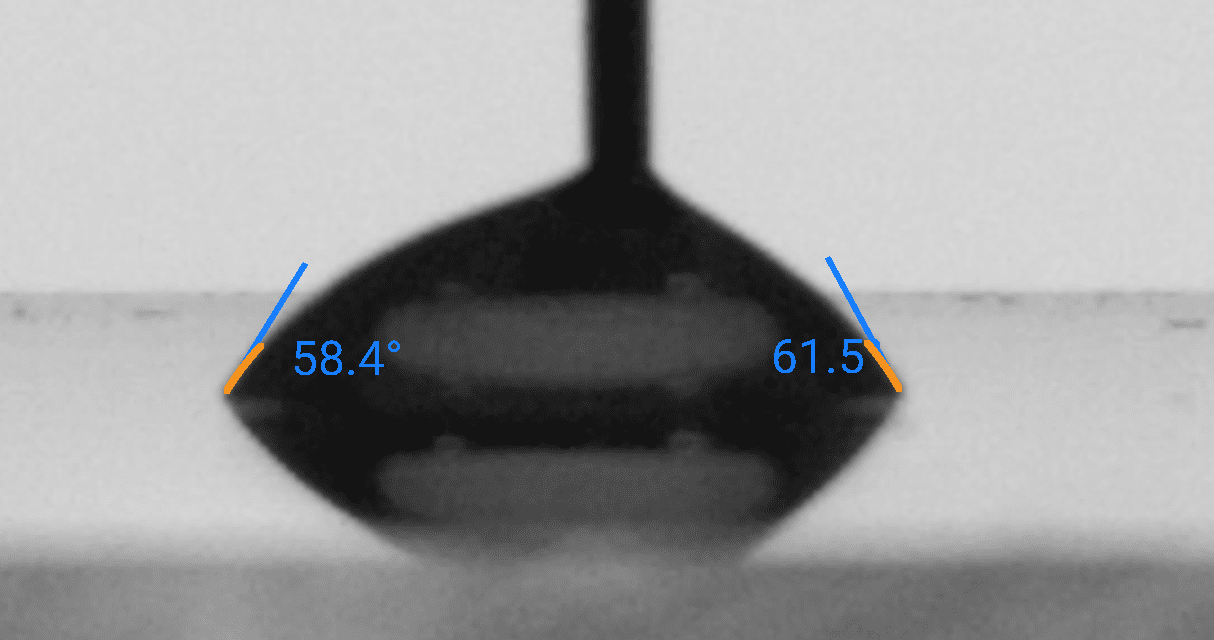
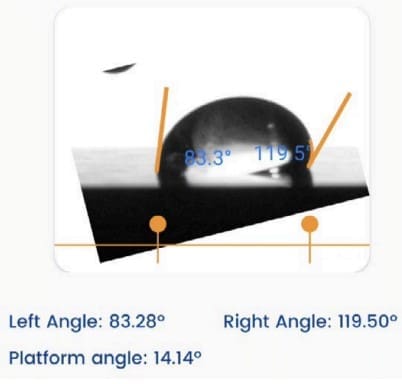
The contact angle quantifies the wettability of a surface by representing the angle between a liquid’s surface and a solid surface.
Dropletlab Research

Sample Image taken from Droplet Lab Tensiometer.

Young – Laplace Method

Metodo polinomiale

Dynamic Contact Angle

Ideally, when we place a drop on a solid surface, a unique angle exists between the liquid and the solid surface. We can calculate the value of this ideal contact angle (the so-called Young’s contact angle) using Young’s equation. In practice, due to surface geometry, roughness, heterogeneity, contamination, and deformation, the contact angle value on a surface is not necessarily a single consistent value but rather falls within a range. The upper and lower limits of this range are known as the advancing and receding contact angles, respectively. The values of advancing and receding contact angles for a solid surface are highly sensitive to many parameters, such as temperature, humidity, homogeneity, and minor contamination of the surface and liquid. For example, the advancing and receding contact angles of a surface can differ at different locations.

Dynamic Contact Angle versus Static Contact Angle

Practical surfaces and coatings naturally show contact angle hysteresis, indicating a range of equilibrium values. When we measure static contact angles, we get a single value within this range. Solely relying on static measurements poses problems, like poor repeatability and incomplete surface assessment regarding adhesion, cleanliness, roughness, and homogeneity.

In practical applications, we need to understand how easily a liquid spreads (advancing angle) and how easily it is removed (receding angle), such as in painting and cleaning. Measuring advancing and receding angles offers a holistic view of liquid-solid interaction, unlike static measurements, which yield an arbitrary value within the range.

This insight is crucial for real-world surfaces with variations, roughness, and dynamics, aiding industries like cosmetics, materials science, and biotechnology in designing effective surfaces and optimizing processes.

Learn how Contact Angle measurement is done on our Tensiometer

For a more complete understanding of Contact Angle measurement, read our Contact Angle measurement: The Definitive Guide

Open Benchmark Data: Contact Angle & Surface Energy

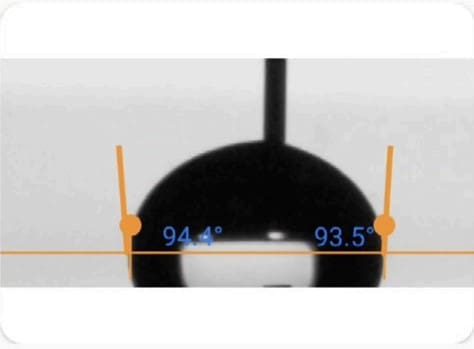
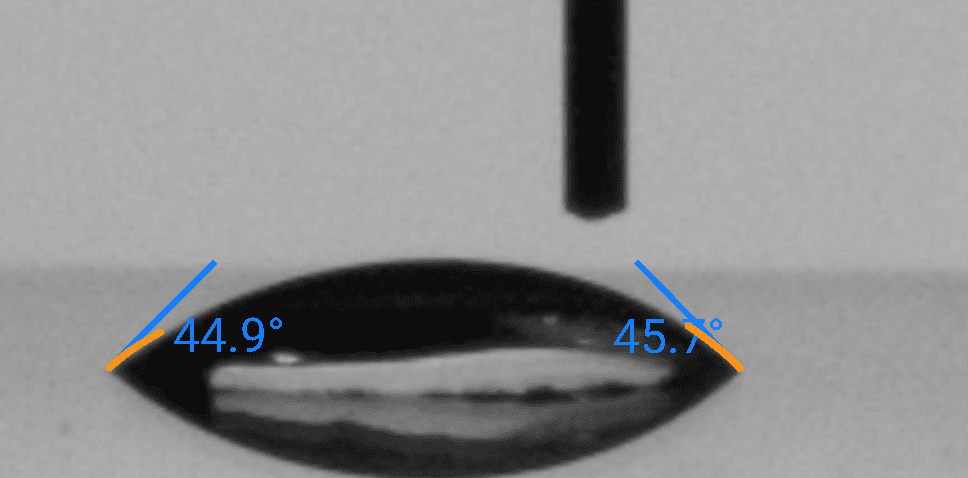
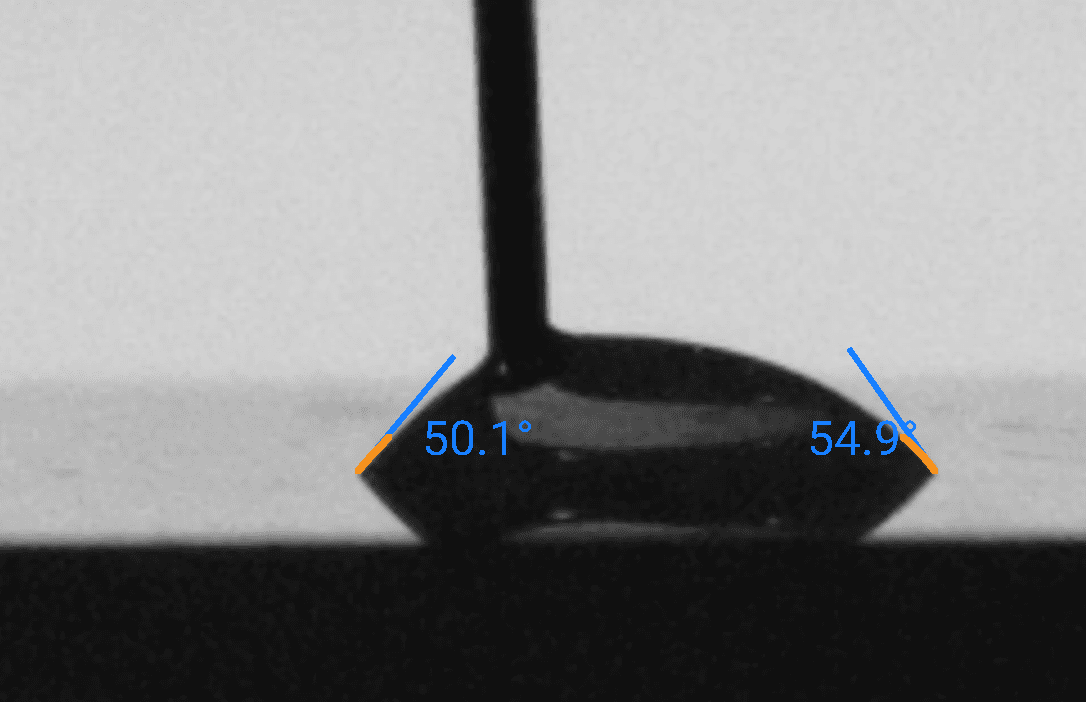
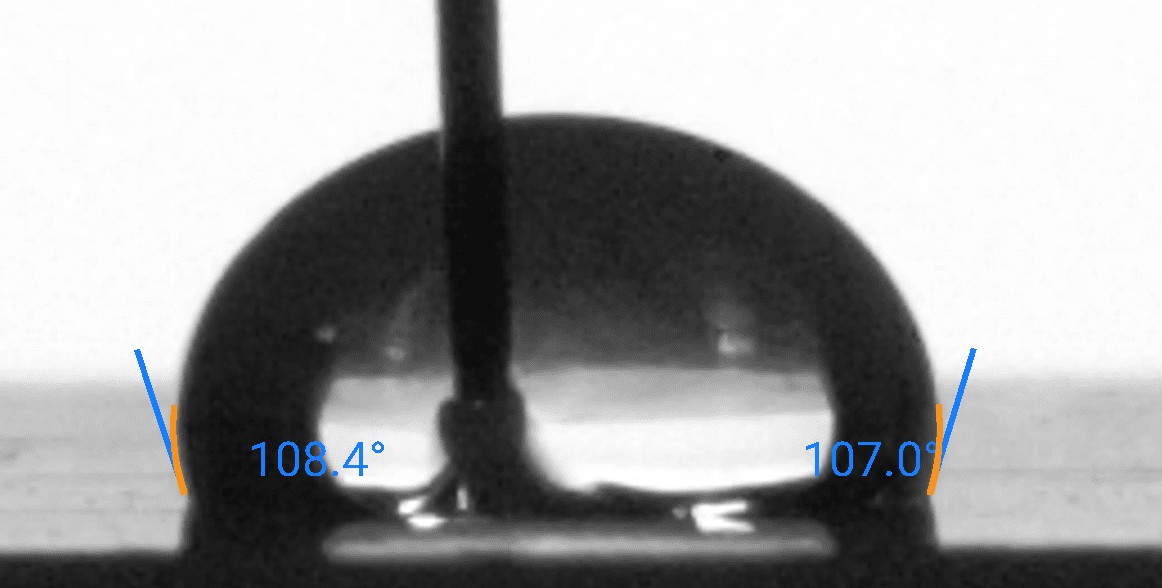
These reference measurements show how deionized water wets four standard substrates measured with the Droplet Lab Dropometer. Use them as visual and numerical benchmarks when you're checking your own sample preparation, treatments, and chemistry.

Full contact angle and surface energy datasets (including additional liquids and statistics) are available on our dataset hub.

Glass - DI Water
Glass - DI Water
Nylon - DI Water
Nylon - DI Water
PMMA - DI Water
PMMA - DI Water
Teflon - DI Water
Teflon - DI Water

The droplet images above are taken from the same benchmark series as our open dataset. For each substrate and probe liquid we report:

● Advancing and receding contact angles (and hysteresis)
● Derived surface energy (SFE) values based on multi-liquid measurements
● Measurement conditions, uncertainties, and sample preparation details

Comparing your own droplet shapes and angles against these references is a fast way to spot contamination, treatment drift, or unexpected changes in wettability.

Chapter 3: Surface Tension Measurement

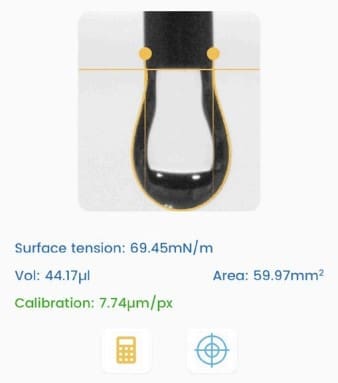
This property measures the force that acts on the surface of a liquid, aiming to minimize its surface area.

Misurazione della tensione superficiale

Sample Image taken from Droplet Lab Tensiometer

Dynamic Surface Tension

Dynamic surface tension differs from static surface tension, which refers to the surface energy per unit area (or force acting per unit length along the edge of a liquid surface).

Static surface tension characterizes the equilibrium state of the liquid interface, while dynamic surface tension accounts for the kinetics of changes at the interface. These changes could involve the presence of surfactants, additives, or variations in temperature, pressure, and composition at the interface.

When to use Dynamic Surface Tension Measurement

Dynamic surface tension is essential for processes that involve rapid changes at the liquid-gas or liquid-liquid interface, such as droplet and bubble formation, coalescence (change in surface area), the behavior of foams, and the drying of paints (change in composition, e.g., evaporation of solvent). It is measured by analyzing the shape of a hanging droplet over time.

Dynamic surface tension applies to various industries, including cosmetics, coatings, pharmaceuticals, paint, food and beverage, and industrial processes, where understanding and controlling the behavior of liquid interfaces is essential for product quality and process efficiency.

Learn how Surface Tension measurement is done on our Tensiometer

For a more complete understanding of Surface Energy measurement, read our Surface Tension measurement: The Definitive Guide

Chapter 4: Surface Energy Measurement

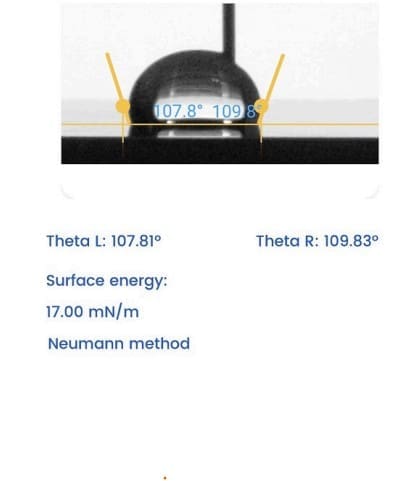
Surface energy refers to the energy required to create a unit area of a new surface.
231

Sample Image taken from Droplet Lab Tensiometer

Learn how Surface Energy measurement is done on our Tensiometer

For a more complete understanding of Surface Energy measurement, read our Surface Energy measurement: The Definitive Guide

For benchmark contact angle and surface energy values on glass, nylon, PMMA, and Teflon, see the Open Benchmark Data panel above or visit our Dataset Hub for full CSV downloads.

Chapter 5: Sliding Angle Measurement

The sliding angle measures the angle at which a liquid film slides over a solid surface. It is commonly employed to assess the slip resistance of a surface.

sliding angle 1

Sample Image taken from Droplet Lab Tensiometer

Learn how Sliding Angle measurement is done on our Tensiometer

For a more complete understanding of Sliding Angle measurement, read our Sliding Angle Measurement: The Definitive Guide

Chapter 6: Real-World Applications

Within the Aviation & Space industry, several case studies exemplify the advantages of conducting surface property measurements.

Polyethylene-based Microfluidic System Approaches to Achieve Adaptive Visible and Thermal Camouflage Applications

This work develops adaptive camouflage approaches spanning the visible and infrared (IR) bands to address increasingly capable visual and IR surveillance. It first demonstrates a low-cost, rapid fabrication method for polyethylene-only microfluidic devices (using xurography and thermocompression/thermal bonding), including a practical method to bond macro-scale polyethylene tubing to micro-scale channels. When filled with dyed liquids, the devices can quickly shift visible appearance to better blend with different backgrounds. The IR appearance is also tunable: by integrating a metalized surface and covering it with an IR-opaque liquid, the apparent temperature can be altered through changes in reflected IR energy rather than changing the system’s true temperature. To overcome slower, pressure-driven flow limitations at smaller scales, a second approach replaces channel filling with a fast electrowetting-on-dielectric strategy. A water droplet actuated at under ~5 V within IR-transparent dodecane can rapidly wet an aluminum electrode using a spontaneously formed lipid bilayer dielectric, enabling fast switching of reflected-IR appearance (on the order of ~1 second). The abstract notes that keeping the dodecane layer below ~1 mm is important to maintain sufficient IR transparency for effective “IR pixel” behavior.

Role of Droplet Lab Goniometer

The Droplet Lab smartphone-based tensiometer/goniometer was used to measure and monitor the electrowetting droplet profile and contact angle during voltage actuation (Chapter 3). This contact-angle quantification is central because the wetting state controls droplet footprint/coverage, which in turn determines how effectively the droplet blocks reflected IR from the metalized electrode surface (the mechanism enabling thermal appearance switching).

The thesis explicitly lists the Droplet Lab system in the equipment used for electrowetting characterization (Chapter 3, Section 3.2.3) and uses it to determine the contact angle change upon actuation (Section 3.2.5.1).

Key Findings

  • Polyethylene microfluidics for visible camouflage: Dyed liquid in polyethylene microchannels enables rapid visible pattern/color adaptation against different backgrounds.
  • IR appearance control without changing real temperature: A metalized layer plus an IR-opaque liquid layer can reduce reflected-IR signature (apparent temperature) through reflection blocking.
  • Low-voltage electrowetting feasibility for fast IR switching: A droplet can transition from hydrophobic to near-complete wetting at very low DC voltage (reported example: 133° → 15° at 3.6 V).
  • Fast actuation: Electrowetting actuation time is reported on the order of ~1 second (average reported as ~1.00 ± 0.33 s).

IR transparency constraint for the oil layer: Thin dodecane layers are needed for strong IR reflection-based contrast; thicker layers attenuate IR and reduce switching effectiveness (abstract highlights <1 mm guidance).

Why it Matters

For aircraft, UAVs, and aerospace vehicles where multispectral detectability is a growing risk, this thesis supports a practical route toward lightweight, flexible, and potentially low-power adaptive skins. The microfluidic approach provides a path for visible pattern adaptation (useful for ground/low-altitude operations), while the electrowetting approach enables rapid IR-signature modulation that could be tuned for changing backgrounds or threat sensors. Quantifying the voltage-driven wetting transition (via contact angle) directly informs design rules for “pixel” geometry, switching speed targets, and acceptable fluid stack thickness, supporting decisions on materials, electrode construction, and QC specs for repeatable signature-management performance.

Method Snapshot

  • Sample: Aluminum-coated (metalized) polyester electrode submerged in dodecane containing 0.8 wt% sorbitan trioleate; water droplet contains 3 wt% SDS (electrowetting configuration).
  • Droplet/Angle/Temp: Droplet contact angle measured as a static contact angle transition (unwetted vs wetted) at ambient conditions, using the Droplet Lab smartphone-based tensiometer/goniometer.

Surface tension context: Interfacial tension (σ_lv) is intentionally reduced by surfactants (SDS + sorbitan trioleate) to lower actuation voltage; no explicit surface-tension measurement value is reported as an instrument output in the thesis text.

Data Note

Figure 13 in the thesis shows the droplet profiles in unwetted (0 V) and wetted (3.6 V) states, with contact angle changing from 133° to 15°. These images and angles are derived from the Droplet Lab digital tensiometer measurements and are the primary visual evidence of low-voltage, near-complete electrowetting.

Figure

Citation (APA Format)

Sun, X. (2023). Polyethylene-based microfluidic system approaches to achieve adaptive visible and thermal camouflage applications (Master’s thesis). University of Alberta

View Publication →

Revolution in the Skies: The Role of Paint in Aircraft Maintenance

Think about it: Airplane paint isn't just for looks. Weighing in at a hefty 500 kg, it significantly impacts the aircraft's fuel consumption.

But it goes beyond weight management. Paint acts as the aircraft's first line of defense against often-overlooked enemies like corrosive rain and harsh UV radiation.

Therefore, aircraft paint needs to meet several crucial demands: high surface energy, excellent wettability, and minimal weight. At Droplet Lab, our tensiometer helps strike this delicate balance, resulting in aircraft paints that are both durable and fuel-efficient.

Revolution in the Skies: The Role of Paint in Aircraft Maintenance

Cell Culture in Space: Navigating the Unique Challenges of Microgravity

Space provides a radically different setting than Earth, affecting everything it touches, including cell culture systems. The unique thermodynamics and mechanics of space make standard ground-based cell culture systems unpredictable. Microgravity and the absence of buoyancy-driven convection cause deviations in behavior. To address these changes, modern research focuses on understanding the dynamics of contact angles and surface properties of cell culture media. By providing researchers with the right tools, such as our tensiometer, we help them optimize space-bound cell culture systems and ensure their findings are accurate and actionable.

Cell Culture in Space: Navigating the Unique Challenges of Microgravity

We are your partners in solving your Business & Technological challenges

If you are interested in implementing these or any other applications, please contact us.

Chapter 7: Standards and Guidelines

In an industry where precision reigns supreme, how can Aviation & Space manufacturers ensure their products withstand scrutiny? The answer lies in standards and guidelines: the compass that guides them through the complex maze of quality and performance.

ASTM F22 — Hydrophobic Surface Films by the Water-Break Test (Surface Cleanliness)

What it is

Standard test method for detecting hydrophobic (non-wetting) surface films by observing whether applied water forms a continuous sheet (“water-break free”) or breaks into beads/patches (“water breaks”). It is a rapid, non-destructive go/no-go screen commonly used to control cleaning and pretreatment steps before aerospace coating, plating/conversion, anodizing, or adhesive bonding.

When to use it

Pre-process cleanliness gate:

Use immediately after cleaning/rinsing (and before priming/painting, conversion coating, plating/anodizing, or bonding) to confirm hydrophobic residues were removed over large areas.

Troubleshooting wetting/adhesion defects:

Use when you see signs like fisheyes/craters, poor coating wet-out, plating skips, or bond failures to quickly screen for hydrophobic contamination and decide whether to re-clean or investigate handling/process drift.

In-scope / Out-of-scope

In scope
  • Large-area screening for hydrophobic films using the visible water sheeting vs water-break behavior.
  • Metallic parts/panels (e.g., aluminum, steel, titanium) where water-break behavior is relevant to downstream aerospace processes.
  • Process control / comparisons (before vs after cleaning changes, detergent concentration drift, rinse quality issues, shift-to-shift monitoring).
  • Optional quantitative supplement: localized water contact angle (WCA) spot checks/mapping (e.g., Dropometer) to add numeric confirmation and variability metrics across representative locations.
Out of scope
  • Universal numeric WCA acceptance limits (must be established internally by correlating WCA to your downstream outcomes for each material + process).
  • Reliable sensitivity on very rough or porous surfaces where water-break response can be muted or inconsistent.
  • Identifying contaminant chemistry/source (requires analytical methods beyond F22/WCA).
  • Surface energy/liquid surface tension measurement or full surface thermodynamics characterization (use other standards/methods).

Minimum you must report (checklist)

  • Substrate/part description (material/alloy, finish, relevant zones/geometry).
  • Cleaning/pretreatment condition (chemistry, key setpoints, dwell/agitation, rinse type/quality, time since cleaning).
  • Water-break result and location(s): “water-break free” vs “water breaks/beads,” plus area/coverage assessed.
  • Water application details (method such as flow/spray/immersion; water type such as DI; temperature if controlled).
  • Handling/environment controls (gloves, wipes, drying method, time-to-test).
  • If using WCA supplement: droplet volume, fixed reporting time (e.g., WCA @ 2.0 s), number of spots (≥5) and spot map/locations.
  • WCA summary statistics (median across spots + variability metric such as IQR), including any rejected/repeated spots and why (tilt, glare, vibration, non-axisymmetric drop, particulates).
  • Control check (a known-good “golden” cleaned reference measured each shift/day) and instrument floor reporting (e.g., record “≤10°” if below the device’s stated range).

Note: ASTM F22 is inherently qualitative; adding localized WCA mapping makes the decision traceable and more sensitive, but it still samples small areas—so use mapped replicates to improve representativeness. If your contact-angle device has a stated lower limit (e.g., 10°), report complete-wetting cases as “≤10°” instead of claiming near-zero angles.

How to interpret results (guardrails)

  • Water-break free + very low WCA (at/near instrument floor): strong evidence of a highly wettable/clean surface for that validated system; proceed if within your internal limits.
  • Water-break free but WCA median rises or IQR increases: early warning of cleanliness drift, patchy residue, or handling contamination—investigate before downstream escapes.
  • Water breaks/beads + high WCA across many spots: likely hydrophobic contamination; re-clean and troubleshoot process inputs (detergent/bath condition, rinse quality, dryer carryover, silicone sources).
  • Mixed map (high IQR, localized high WCA): suggests non-uniform cleaning or localized contamination (edges/recesses/fixtures/packaging/contact points); target corrections and re-test the affected zones.

Now It’s Your Turn

We hope this guide showed you how to apply surface science in the Aviation & Space industry.

Now we’d like to turn it over to you: 

Feel free to leave a comment below—we’d love to hear from you.

Leave a Reply

Your email address will not be published. Required fields are marked *


Scarica l'esperimento