






Contents

Industriale e Meccanico Industria
The Practical Guide to Surface Science (2026)

?s=100&d=m
Written by
No biography added yet.
Read More
?s=100&d=m
Reviewed by
N/A
No biography added yet.
Read More
?s=100&d=m
Written By

No biography added yet.

?s=100&d=m
Reviewed By

N/A N/A

No biography added yet.

This is a practical guide to Surface Science for researchers working in the Industrial and Mechanical Industry.

In this all-new guide you’ll learn all about:

  • Crucial surface science principles
  • The significance of surface science measurements for the Industrial and Mechanical industry
  • Applicable ASTM Standards & Guidelines

Let’s dive right in.

mechanical

Executive Summary

What it covers: A practical playbook for Industrial & Mechanical teams on measuring contact angle (static and dynamic), surface tension (including dynamic), surface energy, and sliding angle, with examples of how these metrics map to real products and processes. It also outlines how to document and interpret results so measurements are comparable and actionable.
Key insights: Real surfaces exhibit contact-angle hysteresis, so advancing/receding (dynamic) angles usually diagnose wetting, cleanliness, roughness, and homogeneity better than a single static value. Dynamic surface tension is the right tool when interfaces change fast (droplet/bubble formation, foams, coalescence, and drying paints), and using benchmarks plus distributions (median/IQR, zone mapping) helps spot contamination and treatment drift quickly.
Business value: These measurements turn “surface feel” problems into quantifiable process controls—improving adhesion, coating performance, lubrication/friction behavior, cleaning validation (e.g., membranes), and reliability in demanding environments (marine, aviation, automotive). They also enable faster troubleshooting and lower scrap/downtime by catching non-uniformity and surface-condition changes before they become defects or failures.
Standards to follow: Use ASTM D8597-24 for portable goniometer contact-angle measurement on real parts, and enforce a strict SOP (fixed droplet volume, fixed capture time, controlled environment, defined sampling map, replicates, and documented QC checks). Establish pass/fail limits only via internal correlation to your acceptance tests, and use follow-on methods such as ASTM D7490 when you need surface-energy estimation or deeper root-cause work.
Bottom line: Pick the measurement that matches the physics of your problem—dynamic contact angles for real-world wetting behavior, dynamic surface tension for fast-changing interfaces, surface energy for adhesion/compatibility, and sliding angle for runoff/slip performance. Run them with disciplined reporting and standards-aligned controls, and they become a dependable decision system for industrial and mechanical design, manufacturing, and maintenance.

Chapter 1: Introduction

Surface properties play a fundamental role in the field of Mechanical and Industrial Engineering. The interaction of materials and components with the environment and other materials takes place primarily on surfaces. For example, the contact between two machine parts, the flow of fluids in pipes, or the adhesion of coatings to substrates. The outcome of all these interactions is influenced by surface properties. As such, they play a critical role on product design, manufacturing processes, and the overall performance of engineered systems. Therefore, understanding and controlling these properties are essential for achieving optimal performance, efficiency, and reliability in various industrial processes and applications.

We use the following surface properties to understand the behavior of Industrial and Mechanical products and improve their quality.

Chapter 2: Contact Angle Measurement

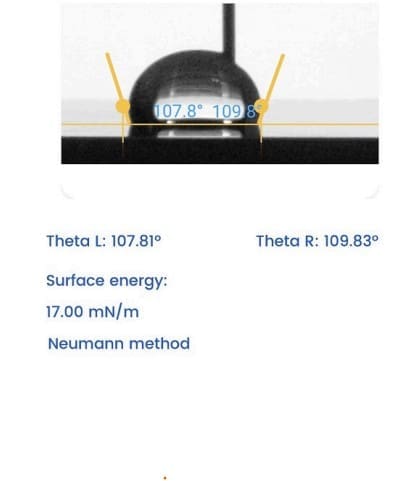
The contact angle quantifies the wettability of a surface by representing the angle between a liquid’s surface and a solid surface.
Dropletlab Research

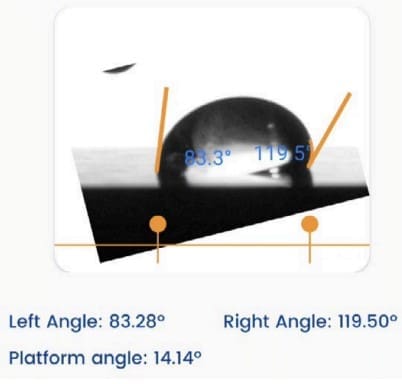
Sample Image taken from Droplet Lab Tensiometer.

Young – Laplace Method

Metodo polinomiale

Dynamic Contact Angle

Ideally, when we place a drop on a solid surface, a unique angle exists between the liquid and the solid surface. We can calculate the value of this ideal contact angle (the so-called Young’s contact angle) using Young’s equation. In practice, due to surface geometry, roughness, heterogeneity, contamination, and deformation, the contact angle value on a surface is not necessarily a single consistent value but rather falls within a range. The upper and lower limits of this range are known as the advancing and receding contact angles, respectively. The values of advancing and receding contact angles for a solid surface are highly sensitive to many parameters, such as temperature, humidity, homogeneity, and minor contamination of the surface and liquid. For example, the advancing and receding contact angles of a surface can differ at different locations.

Dynamic Contact Angle versus Static Contact Angle

Practical surfaces and coatings naturally show contact angle hysteresis, indicating a range of equilibrium values. When we measure static contact angles, we get a single value within this range. Solely relying on static measurements poses problems, like poor repeatability and incomplete surface assessment regarding adhesion, cleanliness, roughness, and homogeneity.

In practical applications, we need to understand how easily a liquid spreads (advancing angle) and how easily it is removed (receding angle), such as in painting and cleaning. Measuring advancing and receding angles offers a holistic view of liquid-solid interaction, unlike static measurements, which yield an arbitrary value within the range.

This insight is crucial for real-world surfaces with variations, roughness, and dynamics, aiding industries like cosmetics, materials science, and biotechnology in designing effective surfaces and optimizing processes.

Learn how Contact Angle measurement is done on our Tensiometer

For a more complete understanding of Contact Angle measurement, read our Contact Angle measurement: The Definitive Guide

Open Benchmark Data: Contact Angle & Surface Energy

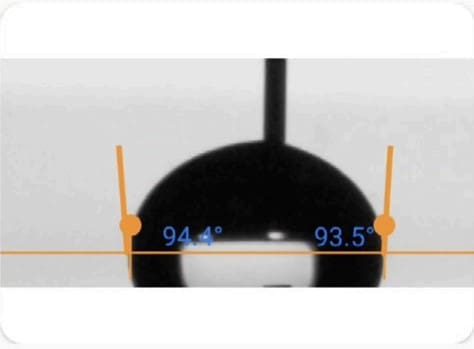
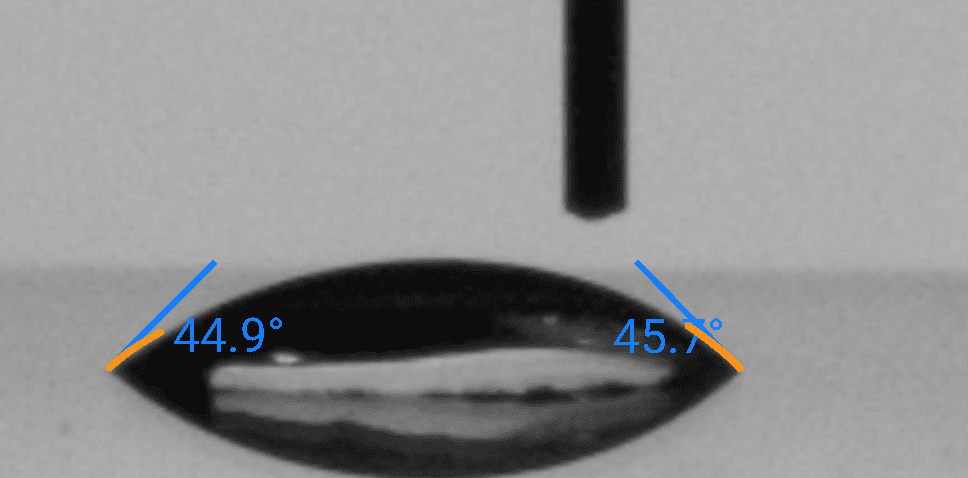
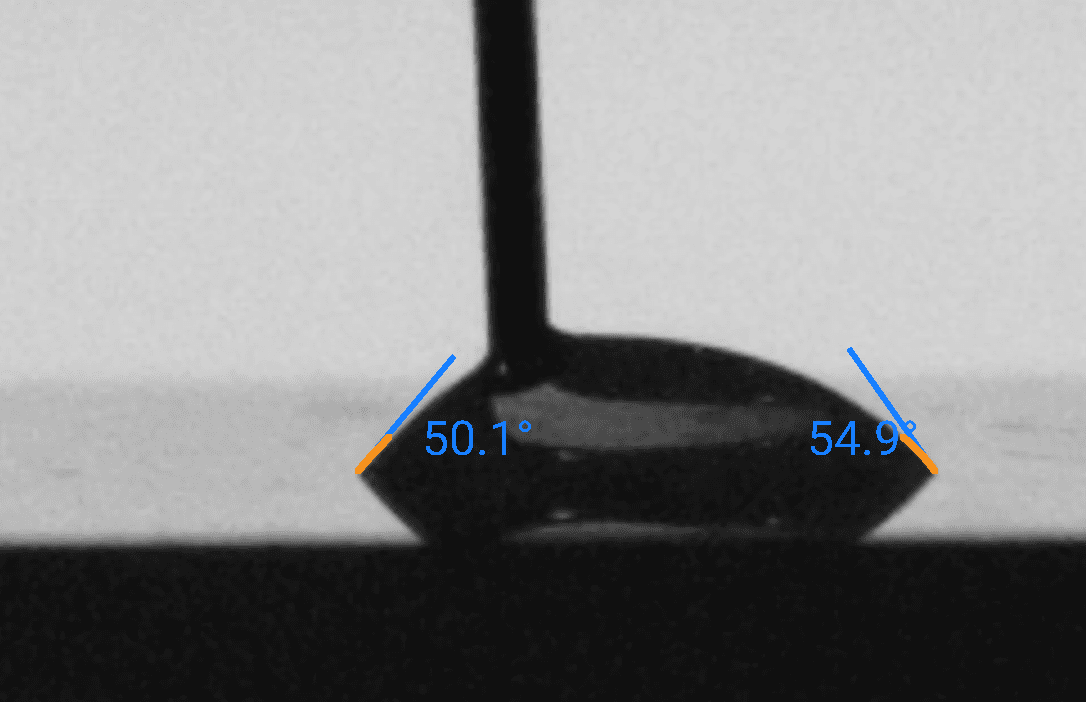
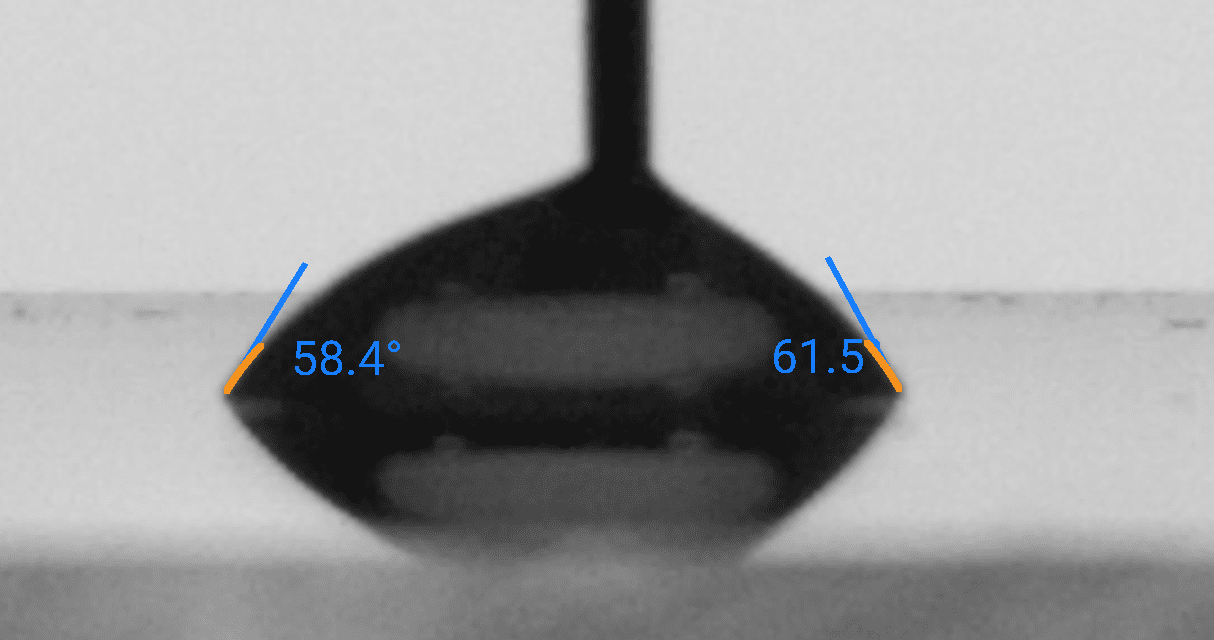
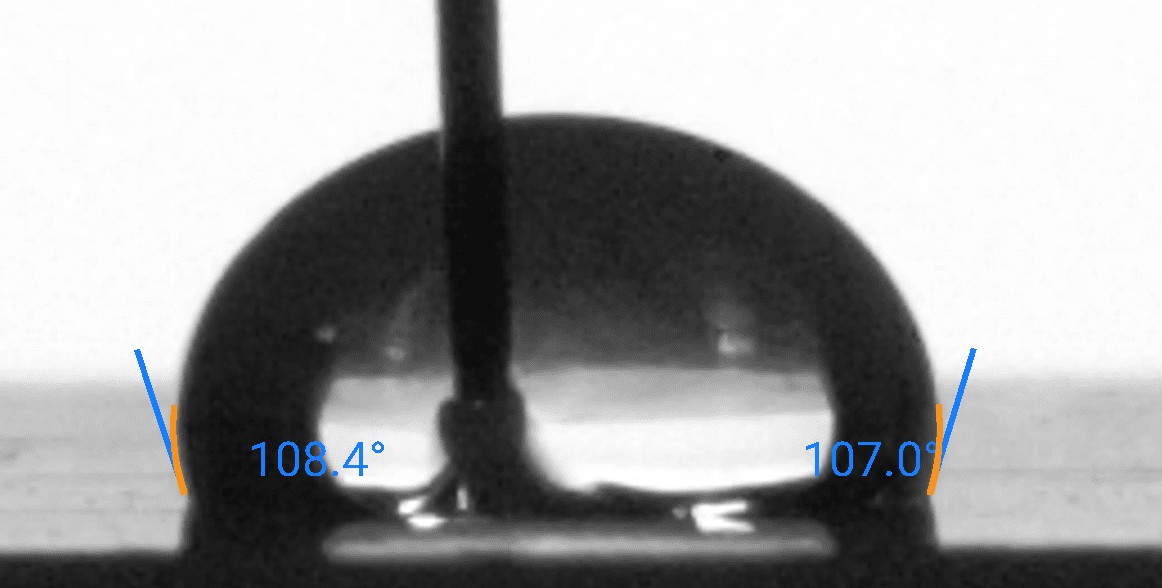
These reference measurements show how deionized water wets four standard substrates measured with the Droplet Lab Dropometer. Use them as visual and numerical benchmarks when you're checking your own sample preparation, treatments, and chemistry.

Full contact angle and surface energy datasets (including additional liquids and statistics) are available on our dataset hub.

Glass - DI Water
Glass - DI Water
Nylon - DI Water
Nylon - DI Water
PMMA - DI Water
PMMA - DI Water
Teflon - DI Water
Teflon - DI Water

The droplet images above are taken from the same benchmark series as our open dataset. For each substrate and probe liquid we report:

● Advancing and receding contact angles (and hysteresis)
● Derived surface energy (SFE) values based on multi-liquid measurements
● Measurement conditions, uncertainties, and sample preparation details

Comparing your own droplet shapes and angles against these references is a fast way to spot contamination, treatment drift, or unexpected changes in wettability.

Chapter 3: Surface Tension Measurement

This property measures the force that acts on the surface of a liquid, aiming to minimize its surface area.

Misurazione della tensione superficiale

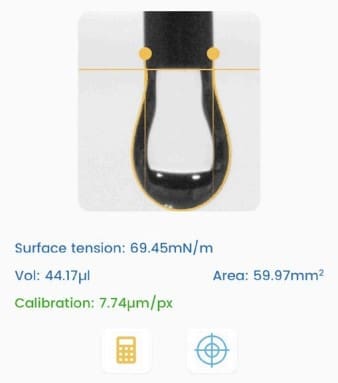
Sample Image taken from Droplet Lab Tensiometer

Dynamic Surface Tension

Dynamic surface tension differs from static surface tension, which refers to the surface energy per unit area (or force acting per unit length along the edge of a liquid surface).

Static surface tension characterizes the equilibrium state of the liquid interface, while dynamic surface tension accounts for the kinetics of changes at the interface. These changes could involve the presence of surfactants, additives, or variations in temperature, pressure, and composition at the interface.

When to use Dynamic Surface Tension Measurement

Dynamic surface tension is essential for processes that involve rapid changes at the liquid-gas or liquid-liquid interface, such as droplet and bubble formation, coalescence (change in surface area), the behavior of foams, and the drying of paints (change in composition, e.g., evaporation of solvent). It is measured by analyzing the shape of a hanging droplet over time.

Dynamic surface tension applies to various industries, including cosmetics, coatings, pharmaceuticals, paint, food and beverage, and industrial processes, where understanding and controlling the behavior of liquid interfaces is essential for product quality and process efficiency.

Learn how Surface Tension measurement is done on our Tensiometer

For a more complete understanding of Surface Energy measurement, read our Surface Tension measurement: The Definitive Guide

Chapter 4: Surface Energy Measurement

Surface energy refers to the energy required to create a unit area of a new surface.
231

Sample Image taken from Droplet Lab Tensiometer

Learn how Surface Energy measurement is done on our Tensiometer

For a more complete understanding of Surface Energy measurement, read our Surface Energy measurement: The Definitive Guide

For benchmark contact angle and surface energy values on glass, nylon, PMMA, and Teflon, see the Open Benchmark Data panel above or visit our Dataset Hub for full CSV downloads.

Chapter 5: Sliding Angle Measurement

The sliding angle measures the angle at which a liquid film slides over a solid surface. It is commonly employed to assess the slip resistance of a surface.

sliding angle 1

Sample Image taken from Droplet Lab Tensiometer

Learn how Sliding Angle measurement is done on our Tensiometer

For a more complete understanding of Sliding Angle measurement, read our Sliding Angle Measurement: The Definitive Guide

Chapter 6: Real-World Applications

Within the Industrial and Mechanical industry, several case studies exemplify the advantages of conducting surface property measurements.

Industrial Membrane Systems: Using Contact Angle to Diagnose Residual Fouling and Validate Cleaning Effectiveness in PVDF AnMBR Membranes

The study evaluates PVDF membrane performance in a thermophilic submerged anaerobic membrane bioreactor treating pulp and paper primary sludge at different solids retention times. It quantifies how well a standard physical + chemical cleaning sequence restores flux and characterizes what residual foulants remain after cleaning, highlighting opportunities to optimize industrial cleaning protocols.

Role of the Droplet Lab Goniometer

The Droplet Lab goniometer (referred to in the paper as a Droplet Smart Tech Inc. sessile contact angle system) was used to measure water contact angle as a direct indicator of membrane surface wettability/hydrophilicity—a key surface property linked to fouling propensity and cleaning effectiveness.

  • The study used a sessile drop contact angle method with a 3 µL water droplet, performed in triplicate on both mixed liquor and membrane samples (reporting averaged values).
  • This type of workflow aligns with Droplet Lab capability for contact angle testing (e.g., 10°–175° range, 0.01° resolution, 0.35° accuracy) and supports small-droplet dosing capability (minimum drop volume with automatic dosing 0.05 µL).
Key Findings

  • The applied cleaning protocol restored ~84%–94% of flux (normalized via permeability testing), but residual foulants still remained—indicating incomplete cleaning effectiveness.
  • Cake/gel layer formation dominated resistance (reported as ~97% of total resistance in the related discussion), supporting the importance of physical cleaning in addition to chemicals.
  • Wettability changed after operation: the contact angles of employed membranes decreased by 20%, 24%, and 39% for 32-, 45-, and 55-day SRT conditions, respectively (significant effect of SRT on contact angle).
  • Longer SRTs increased fouling severity (e.g., higher average fouling rate) and were associated with more persistent residual fouling signals even after cleaning.

Why It Matters

For industrial membrane equipment designers and operators, this paper shows how contact angle can function as a fast surface-quality metric to complement permeability/TMP tracking. If flux recovery looks “acceptable” but wettability shifts substantially, that can indicate surface-condition changese residual foulant interactions that may accelerate re-fouling, shorten membrane life, and increase downtime. Embedding contact angle checks into cleaning validation (and membrane autopsy workflows) can support cleaning recipe optimization, maintenance scheduling, and membrane replacement decisions.

Method Snapshot

  • Sample: Flat-sheet PVDF membrane module (0.1 µm pore size) used in thermophilic submerged AnMBR treating pulp and paper primary sludge; membrane samples taken for characterization after cleaning steps.
  • Droplet & angle type: 3 µL water droplet, sessile contact angle (static CA implied), triplicate measurements.
  • Surface tension: Not reported/measured in the provided methods/results text.

Data Note

Where contact angle data are reported: The paper reports contact angle changes (percent decreases by SRT) in the “Membrane surface properties” results discussion—immediately following the SEM/roughness discussion—rather than in a dedicated contact-angle figure/table.

Citation (APA Format)

Bokhary, A., Leitch, M., & Liao, B. Q. (2025). Membrane performance evaluation and residual fouling characterization in a thermophilic submerged AnMBR treating pulp and paper primary sludge at varying solids retention times. Separation and Purification Technology, 358, 130438. https://doi.org/10.1016/j.seppur.2024.130438

View Publication →

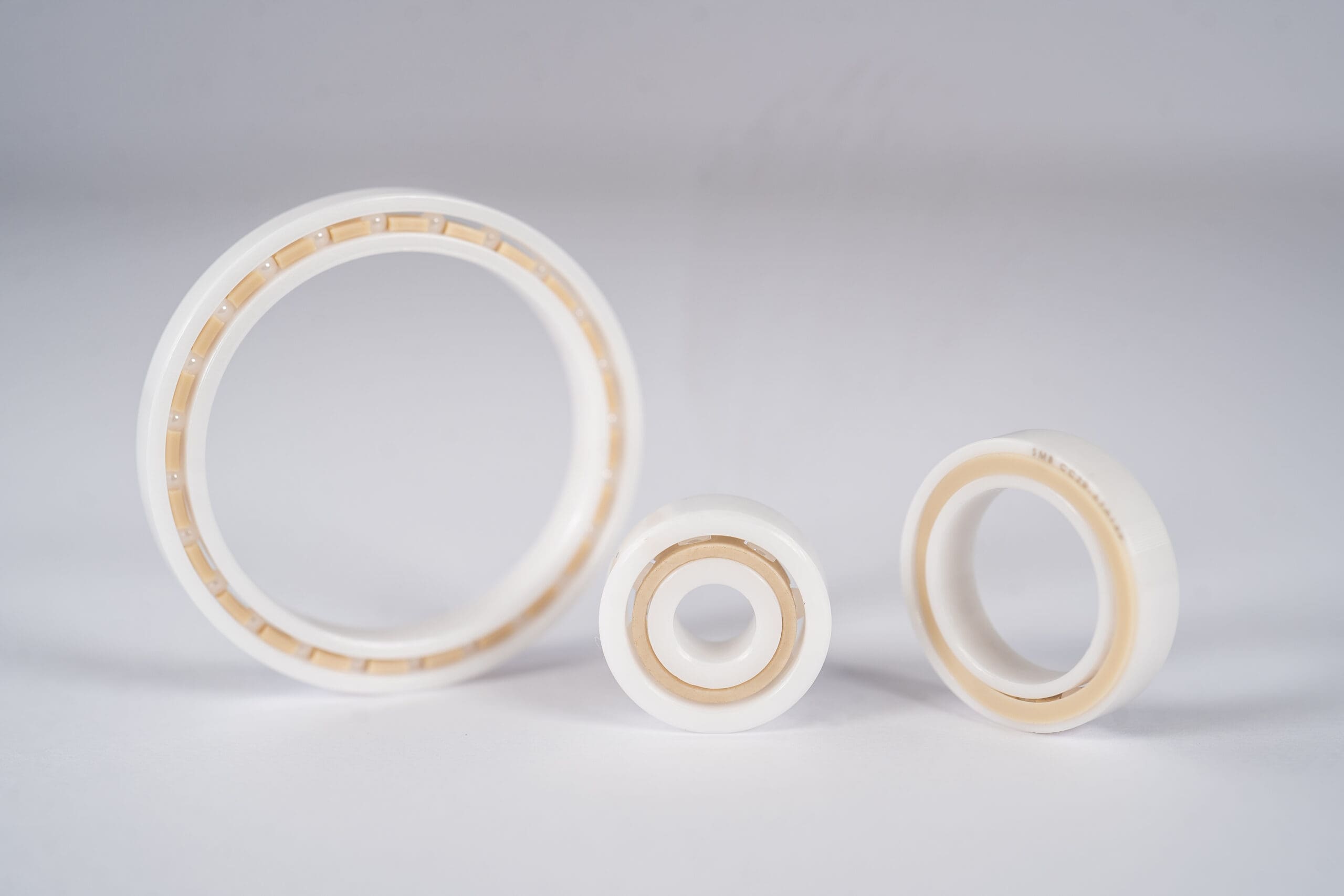
Hydrophobic Bearings for Marine Applications

Challenge: In the marine engineering field, maintaining the performance of underwater equipment such as bearings is critical.

Solution: Engineers have worked on hydrophobic bearings for submerged applications by creating low sliding angle surfaces. The hydrophobicity in bearings helps in reducing the friction between moving parts in underwater machinery, such as ship propellers and underwater vehicles. Lower sliding angles help in smoother operation, increased efficiency, and reduced wear and tear enhancing the reliability of marine equipment.

Hydrophobic Bearings for Marine Applications

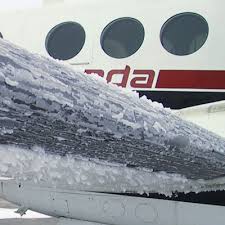
Aircraft Icing Prevention 

Challenge: In the aviation industry, ice formation on aircraft surfaces is a big concern. Ice accumulation on aircraft wings disrupts airflow which leads to reduced lift and control.

Solution: Engineers have worked on an anti-icing systems that depends on contact angles. By carefully controlling the contact angle superhydrophobic surfaces are created. It makes sure that ice cannot easily stick to the aircraft's wings and surfaces. The new superhydrophobic surface enhanced safety by preventing ice accumulation and reduced the weight and energy consumption associated with traditional de-icing methods.

Aircraft Icing Prevention 

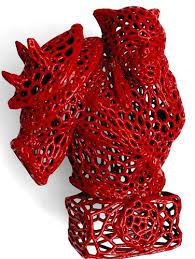
Enhanced 3D Printing

Challenge: In 3D Printing, controlling the surface tension of printing materials is essential for achieving precise and high-quality prints.

Solution: Engineers have developed 3D printing material that has relatively low surface tension. Lower surface tension promotes better wetting and adhesion of the printing material to the build surface and between successive layers. Therefore, the new 3D printing material will offer improved print quality, reduced defects such as warping and delamination, and enhanced overall printing reliability. It will help the 3D printing material spread evenly across the build surface, creating strong bonds between layers and will reduce the likelihood of issues like "elephant's foot" (excessive material squishing at the first layer) or "stringing" (unwanted thin strands of material).

Enhanced 3D Printing

Medical Devices and Blood Repellency

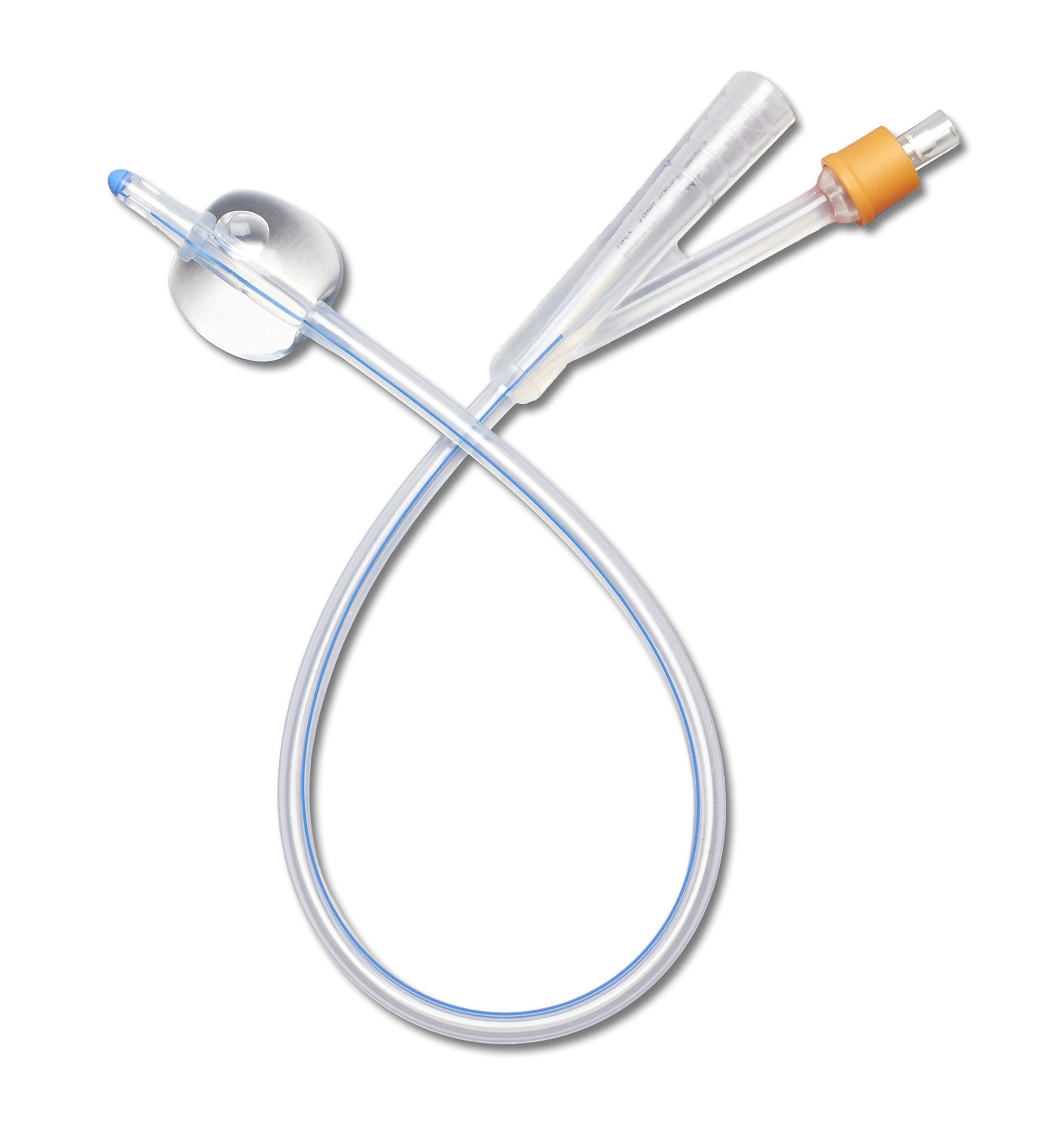
Challenge: The development of devices like Catheters requires blood-repellent surfaces to prevent clotting and ensure smooth functioning.

Solution: In the medical industry, a superhydrophobic coating with a high contact angle is applied to the surfaces of medical devices. This creates a non-wetting surface that can repel blood and other bodily fluids. The high contact angle prevents blood from sticking to the surface of medical devices, reducing the risk of clot formation. It enhances the overall performance and safety of these devices.

Medical Devices and Blood Repellency

Automotive Windshields and Rain Repellency

Challenge: In the automotive industry, it is important to maintain visibility during rain for driver safety.

Solution: In traditional windshield surfaces, water buildup is a common problem. It reduces visibility compromising driver safety. The industry has a unique solution to enhance rainwater repellency. A hydrophobic coating with a low sliding angle is applied to automotive windshields. The low sliding angle makes sure that rainwater easily slides off the surface. It improves visibility during wet conditions. The hydrophobic coating significantly reduces water buildup on windshields, leading to improved driver visibility and safety during rainy weather.

Automotive Windshields and Rain Repellency

We are your partners in solving your Business & Technological challenges

If you are interested in implementing these or any other applications, please contact us.

Chapter 7: Standards and Guidelines

In an industry where precision reigns supreme, how can Industrial and Mechanical manufacturers ensure their products withstand scrutiny? The answer lies in standards and guidelines: the compass that guides them through the complex maze of quality and performance.

ASTM D8597-24 — Surface Wettability by Contact Angle Using Portable Goniometers

What it is

ASTM D8597-24 describes a method to measure the contact angle of a deposited liquid droplet using a portable (handheld) goniometric device to assess surface wettability on real parts. It enables documented, comparable line-side/field wettability checks when measurement conditions are controlled through a consistent SOP.

When to use it

Line-side / field wettability screening on real parts

Use when parts are too large or impractical to coupon (e.g., coated panels, films, molded components, large assemblies) and you need a non-destructive, traceable wettability check at the point of use.

Uniformity verification after cleaning, treatment, or handling

Use when you need to map zone/lane variability (edge/center/edge, drive/operator side, lane-by-lane) to detect non-uniform treatment or localized contamination risk.

In-scope / Out-of-scope

In scope
  • Portable/handheld goniometric devices for sessile-drop contact-angle measurement
  • Measuring contact angle (θ) from an imaged droplet profile on a substrate/part surface
  • Fixed-time or otherwise standardized capture/reporting defined in your SOP for comparability
  • Mapping wettability across zones/lanes/placements to evaluate surface uniformity
Out of scope
  • Pass/fail adhesion or printability claims without correlating θ to your acceptance tests (adhesion, defects, peel strength, etc.)
  • Identifying the chemical origin of contamination/non-uniformity (often requires follow-on analytics)
  • Direct measurement of liquid surface tension or definitive surface energy without appropriate follow-up methods
  • Assuming results transfer across different liquids/surfaces/process states unless validated (material, roughness, storage history, etc.)

Minimum you must report (checklist)

  • Surface identification & condition: material/coating, finish, treatment history, and state (“as received / post-clean / post-treatment / post-storage”)
  • Test liquid: identity and quality controls (e.g., DI water), plus batch/handling notes as applicable
  • Droplet volume setpoint: one locked value used for all measurements in the dataset
  • Capture time: the fixed timestamp after placement used for θ reporting (e.g., “θ @ 1.5 s”)
  • Measurement definition & results: which θ is reported (e.g., left/right/average if applicable), plus replicates and distribution stats (at minimum median + IQR)
  • Sampling plan: number of placements per zone and the zone/lane map plan (where points were taken)
  • Environment: temperature and relative humidity (or equivalent conditions impacting comparability)
  • Data quality controls: instrument leveling/calibration checks, “golden panel” or reference surface results, and documented rejects (glare/tilt/edge-fit failure/droplet motion) with frames flagged for audit traceability

Note: ASTM D8597 describes the measurement method; your “GO / HOLD” thresholds must be established by internal correlation to real outcomes on your surfaces with your liquids. This guide-style summary does not confer ASTM certification—purchase and follow the official ASTM standard for full requirements.

How to interpret results (guardrails)

  • Lower θ (with the same liquid, volume, and timestamp) generally indicates easier wetting and typically lower wetting-related risk, but only your correlation study can define what “good” means.
  • Higher θ generally indicates poorer wetting and elevated risk—investigate contamination, insufficient treatment, or storage/handling changes.
  • Use distributions, not single drops: median shifts suggest global process changes; widening IQR and zone-pattern signatures suggest non-uniformity (treatment/handling/lane effects).
  • Escalate when decisions are high-stakes or chemistry separation is needed: repeat under controlled conditions and, where appropriate, add deeper methods (e.g., two-liquid solid surface property estimation via ASTM D7490 and/or analytical tools) to identify root cause.

Now It’s Your Turn

We hope this guide showed you how to apply surface science in the Industrial and Mechanical industry.

Now we’d like to turn it over to you: 

Feel free to leave a comment below—we’d love to hear from you.

Leave a Reply

Your email address will not be published. Required fields are marked *


Scarica l'esperimento