15–20%
of annual revenue consumed by Cost of Poor Quality in typical manufacturing operations
American Society for Quality

Add a numeric, audit-ready wettability screen between surface preparation and bonding. Stop adhesive failures that originate upstream before the adhesive is ever applied.
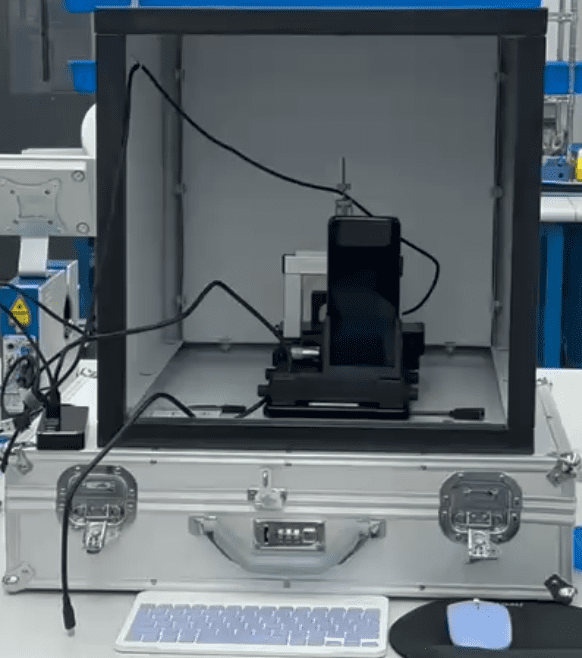
Who this is for: Process engineers, QA/QC teams, and manufacturing leads responsible for adhesive bonding quality enhancement, especially when yield loss comes from intermittent bond failures.
Positioning: Dropometer does not replace bond-strength verification tests. It adds quantitative wetting and variability data that anticipates and explains outcomes, so teams run fewer failed builds and troubleshoot faster.
Droplet Lab builds precision instruments and software for surface science measurement, specialising in contact angle analysis and surface tension characterisation. Used by researchers across materials science, pharmaceuticals, coatings, and advanced manufacturing, Droplet Lab's Dropometer has contributed to studies published in peer-reviewed journals including Advanced Functional Materials (Impact Factor 19). The team combines instrument engineering with deep domain knowledge in wettability science with a focus on practical accuracy.
of annual revenue consumed by Cost of Poor Quality in typical manufacturing operations
American Society for Quality
higher hidden cost vs. visible scrap cost — rework, re-inspection, downtime, and warranty claims are rarely captured
Lean Six Sigma research consensus
upstream prevention typically saves $10 in internal rework and up to $100 in external warranty and recall costs
COPQ prevention-to-failure ratio
Sources: ASQ, Learn Lean Sigma, Fabrico COPQ Guide 2026. Figures are industry-wide benchmarks, not Droplet Lab claims.
Quick technical reference for engineers and QA managers evaluating fit before reading further.
Adhesive failures discovered after bonding, cure, or assembly where the root cause was contamination, inconsistent surface prep, or uncontrolled time-to-bond that occurred upstream.
A fast quantitative screen before bonding and a structured troubleshooting tool when adhesive quality begins to drift. Not a replacement for final bond-strength testing.
- Water contact angle at a fixed time
- Replicate spread across spots or zones
- Optional surface energy trend analysis using Neumann, Fowkes, or van Oss-Good models
- 10–20 representative samples spanning pass and fail outcomes
- Minimum 2 operators
- Locked probe fluid, droplet volume, capture time, and replicate count
PASS / MONITOR / FAIL thresholds must be set by correlating measured wetting signals to your actual acceptance outcomes; substrate-specific, not universal.
Contact angle is a process-risk indicator, not direct proof of bond durability. Cure drift, adhesive chemistry mismatch, and application errors require separate process controls.
The Dropometer serves four roles across an adhesive bonding operation. Each has a different primary risk. Jump to yours.
Investigating batch-to-batch or shift-to-shift variation in bond quality with no clear root cause.
Needing a numeric upstream gate before bonding to reduce post-assembly rework and improve first-time yield.
Requiring documented, defensible evidence of surface readiness for NCR files, CAPA responses, or supplier audits.
Setting up a reproducible measurement protocol for incoming substrate inspection or treatment verification across operators.
This is not a universal solution. Check the conditions below before investing further time.
In most bonding lines, adhesive failure is a late symptom. The root cause is earlier and preventable with the right upstream gate.
Adhesive failure is typically discovered after scrap, rework, downtime, or customer complaints have already occurred. The failure is often attributed to the adhesive. In many cases the adhesive is not the problem. The substrate surface was not ready for bonding.
Common upstream causes include contaminants such as oils, release agents, dust, oxidation products, or cleaning residue; inconsistent surface preparation; low surface energy from substrate chemistry or coating variation; and time-to-bond delay after treatment. All of these are measurable before the adhesive is applied.
This workflow adds a quantitative upstream gate. First, measure wetting readiness on the substrate before the adhesive is applied. Second, use the same measurement logic for troubleshooting when performance begins to drift. The goal is not to predict bond strength from one number. The goal is to reduce false passes, identify root cause faster, and prevent adhesive bond problems from advancing deeper into production where they cost more.
Adhesive failure often shows up late, after bonding, cure, or assembly, because upstream risk (surface condition, handling, and cure-control drift) was not screened quantitatively. Many failures are process-driven rather than random.
Why:
How to detect:
Corrective action:
Why:
How to detect:
Corrective action:
Why:
How to detect:
Corrective action:
A surface science specialist can review your failure history and help you identify whether a surface screen would add a useful upstream gate.
Surface readiness measurement produces the type of numeric, traceable output that subjective visual methods cannot. If your quality system requires documented evidence of process control at each stage for NCR responses, CAPA files, incoming inspection records, or supplier audits contact angle measurement provides that evidence in a format your QA documentation already requires.
Numeric contact angle values with replicate spread, timestamps, operator records, and lot identification; replacing subjective "surface looked clean" notes with defensible numeric logs.
When adhesive failures trigger a Corrective and Preventive Action file, contact angle data provides quantitative before/after evidence of surface condition; not anecdotal process descriptions.
Non-conformance reports that include numeric pre-bond contact angle data allow you to assign root cause to the surface preparation step with evidence not inference.
Incoming substrate inspection using contact angle measurement provides a numeric acceptance criterion for supplier lot approval applicable to ISO 9001, IATF 16949, and FDA-regulated environments.
Contact angle trend logs demonstrate statistical process control at the surface preparation step; an argument relevant to Six Sigma, SPC, and DMAIC programs targeting adhesive-related COPQ.
For plasma, corona, or primer steps that are difficult to verify visually, contact angle measurement provides an objective confirmation that treatment reached the required activation level before bonding proceeds.
Why it matters: This is the fastest screen for whether a substrate is ready for adhesive wetting.
How to interpret: Lower angle usually means easier wetting. Rising angle versus baseline indicates higher risk. Compare median values, not a single droplet reading.
When it is not enough: Contact angle confirms wetting readiness, not bond strength. If contamination chemistry must be identified, FTIR-ATR, XPS, or ToF-SIMS is required.
Why it matters: A single average can hide a localized issue. Variability is often what reveals intermittent adhesive failure.
How to interpret: Low variability suggests a stable surface. High variability suggests contamination, uneven treatment, or handling effects. Fixed-location checks can show whether the issue is at edges, lanes, or touch points
When it is not enough: High spread signals a non-uniform surface but does not identify whether the cause is contamination, uneven treatment, or substrate texture.
Why it matters: Dropometer supports surface energy analysis using Neumann, Fowkes, and van Oss-Good models, which can help distinguish a truly low-energy substrate from a contamination-driven wetting shift.
How to interpret: Surface energy values are model-dependent and most useful as comparative indicators between lots or treatments, not as absolute physical constants. Do not compare values calculated using different models.
When it is not enough: It is not chemical identification and should not replace root-cause confirmation methods when chemistry must be proven.
Why it matters: Even good wetting can still lead to bond failure if cure and handling controls are poor.
How to interpret: Missing or out-of-range logs mean process risk. Delays between prep and bonding can lead to bond failure. UV, thermal, or ambient cure rules must be held constant
When it is not enough: Logging cure parameters confirms the process ran within specification. It does not confirm the bond achieved rated mechanical strength, which requires destructive acceptance testing on finished parts.
Independent benchmarking and publication-based validation references.
Benchmark Validation
Our Contact angle and pendant‑drop surface tension methods have been benchmarked against KRÜSS DSA100E reference measurements.
Publication Evidence
Our instruments are referenced in peer‑reviewed journals, theses, and conference publications
Dropometer is best used as a pre-bond QC screen and as a structured troubleshooting step after adhesive failure begins to trend.
“We completed our gage R&R study on the unit and it performed very well.”
Brandon Barbee, Corporate Quality Engineer - Zeus Industries - Polymer Manufacturing
An editable SOP template your team can adapt for your substrate, adhesive, and preparation route. Includes measurement protocol, gate-setting guidance, and a QC log format ready for your documentation system.
Your goal is not to invent universal thresholds rather to create site-specific gates that are defensible.
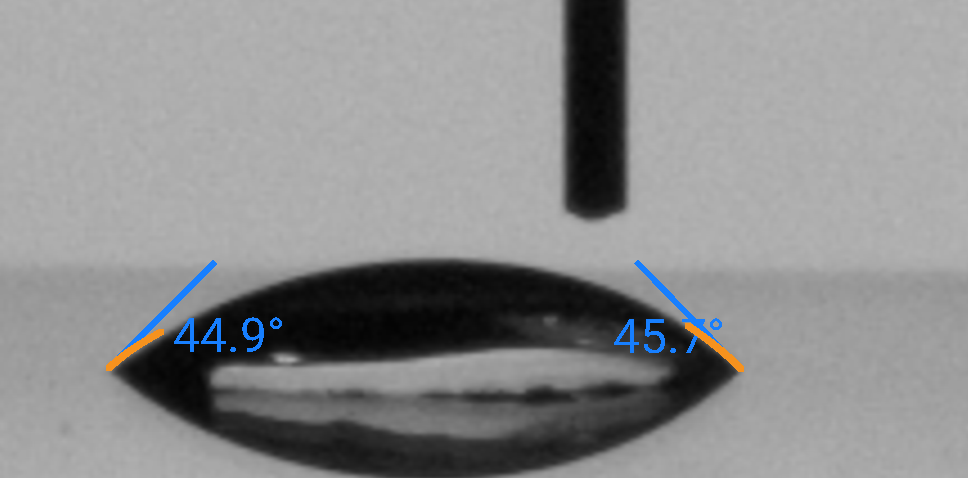
Representative output format. Values are illustrative; your site-specific gates will differ based on your calibration study.
Dropometer contact angle measurement — DI water on glass. Left contact angle: 44.9°, right: 45.7°. Blue lines show the fitted tangent at each contact point; orange lines show the baseline. This is the type of output used to make a pre-bond PASS / HOLD decision.
| Spot | Contact Angle (°) | Replicate SD | vs. Baseline | Gate Result |
|---|---|---|---|---|
| Zone A — Centre | 22.4° | ±1.1° | Within range | PASS |
| Zone A — Centre | 24.1° | ±1.4° | Within range | PASS |
| Zone C — Edge right | 38.7° | ±4.2° | +14.6° above median | MONITOR |
| Zone D — Operator contact | 61.2° | ±6.8° | +37.1° above median | HOLD |
| Zone E — Centre repeat | 23.0° | ±0.9° | Within range | PASS |
Zone D result indicates localized contamination at an operator-handling point. Part held for re-cleaning before bonding proceeds. Zones A, B, E cleared. Zone C flagged for follow-up check after re-handling. This output would be included in the pre-bond QC record for this lot.
Simple checklist for pre-bond release gating
Goal: Prevent adhesive failure before bonding by screening substrate readiness and escalating only when needed.
No. The Dropometer is an upstream screening tool. It measures wetting readiness — contact angle and surface energy — before the adhesive is applied. It does not measure bond strength. Your existing peel, lap shear, or pull-off tests remain the acceptance standard for finished parts. What it replaces is the current absence of any pre-bond gate.
There is no universal threshold. Acceptable wetting angles depend on your substrate, adhesive, and surface preparation route. You establish your own PASS / MONITOR / FAIL gates by correlating measured contact angles to your historical bond outcomes on a per-substrate-family basis. The Dropometer provides the measurement; your calibration study establishes the gate.
Yes. Contact angle measurement is a direct indicator of surface activation level after plasma, corona, flame, or primer treatment. Verifying that treatment was effective and consistent before bonding is one of the most common applications of the Dropometer in production environments.
Yes. The Dropometer produces numeric contact angle logs with replicate data, timestamps, and operator records. These outputs can be included in NCR documentation, CAPA files, incoming inspection records, and supplier audit packages — wherever numeric evidence of process control is required.
The water break test is a pass/fail visual assessment with no numeric output. It cannot detect marginal wettability, track process drift over time, compare lots against a documented baseline, or provide audit-defensible records. Contact angle measurement quantifies what the water break test only estimates — and generates the documented data trail that visual methods cannot.
| Metric | Before Dropometer | With Dropometer | Indicative Benchmark |
|---|---|---|---|
| Failure discovery point | Post-assembly, after adhesive, cure, and handling costs are already sunk | Pre-bond surface screen — before value is added downstream | Assembly rework costs 5–10× more than upstream hold and re-treat |
| Troubleshooting cycle | Multi-day, opinion-driven: no numeric baseline to compare against | Same-shift, data-driven — wetting signal isolates surface vs. cure vs. application as cause | Structured data-driven diagnosis vs. iterative trial-and-error |
| Operator-to-operator variation | Unmeasured: no way to distinguish surface variability from process variability | Tracked per run, per operator, per zone — makes invisible drift visible | Replicate spread detects handling damage not visible to the eye |
| Audit documentation | Subjective notes ("surface looked clean"): not defensible under audit | Numeric contact angle logs with timestamps, operator records, and lot ID | Applicable to NCR, CAPA, incoming inspection, and supplier qualification records |
| Rework and scrap cost | Included in cost standards and warranty allowances; often treated as unavoidable | Surface failures intercepted before assembly — converts late defects to early holds | COPQ from rework typically 15–20% of revenue for manufacturers without upstream gates |
| Treatment verification | No objective confirmation that plasma, corona, or primer activation was effective | Numeric confirmation of activation level before each production run proceeds | Eliminates reliance on time-since-treatment assumptions |
Calculate your savings in real time
Instant ROI Snapshot
Result
Where do these numbers come from? i You enter your current total time per test (dispense + record + analyze + save). The calculator assumes that our Dropometer reduces that workflow to ~1.1 minutes per test (dispense + capture + automated fit + export). Time saved per test = max(0, your time − 1.1 min). Monthly hours saved = (monthly tests × minutes saved per test) ÷ 60, and monthly savings = hours saved × labor rate.
Knowing the limits of any measurement tool is part of using it correctly. These are the boundaries of what this workflow addresses.
Use this page to improve prevention and upstream troubleshooting, not to oversimplify adhesion science. The Dropometer is one layer in a quality system, not a substitute for one.
Polymer bonding
Low surface energy polymers require surface activation to bond. Measure wettability before bonding to verify treatment effectiveness.
Metal bonding
Aluminum oxide formation and surface contamination are the leading causes of aluminum bond failure. Quantify surface readiness before assembly.
Treatment verification
Confirm that plasma treatment reached the required activation level before bonding proceeds — with a numeric record for each production run.
Editorial and technical transparency notes for this page.
An initial draft was created with AI assistance (ChatGPT 5.2 Pro and Claude 4.8 Opus)
Reviewed and edited for technical accuracy by Droplet Lab Team.
Standard identifiers, units, thresholds, and key procedural claims are checked against cited sources before publication
Reviewed every 12 months or when the underlying standard changes.
Spotted an issue in this summary? Send a correction request and our team will review it.
Correction Request
We work hard to keep this standards summary accurate and up to date. If you spot an error (wrong revision/year, missing requirement, incorrect interpretation, or broken link), tell us and we'll review it.
Contact us to report a correction